Multi-Peptide Blends Explained: GLOW, KLOW, and BPC/TB in Laboratory Research
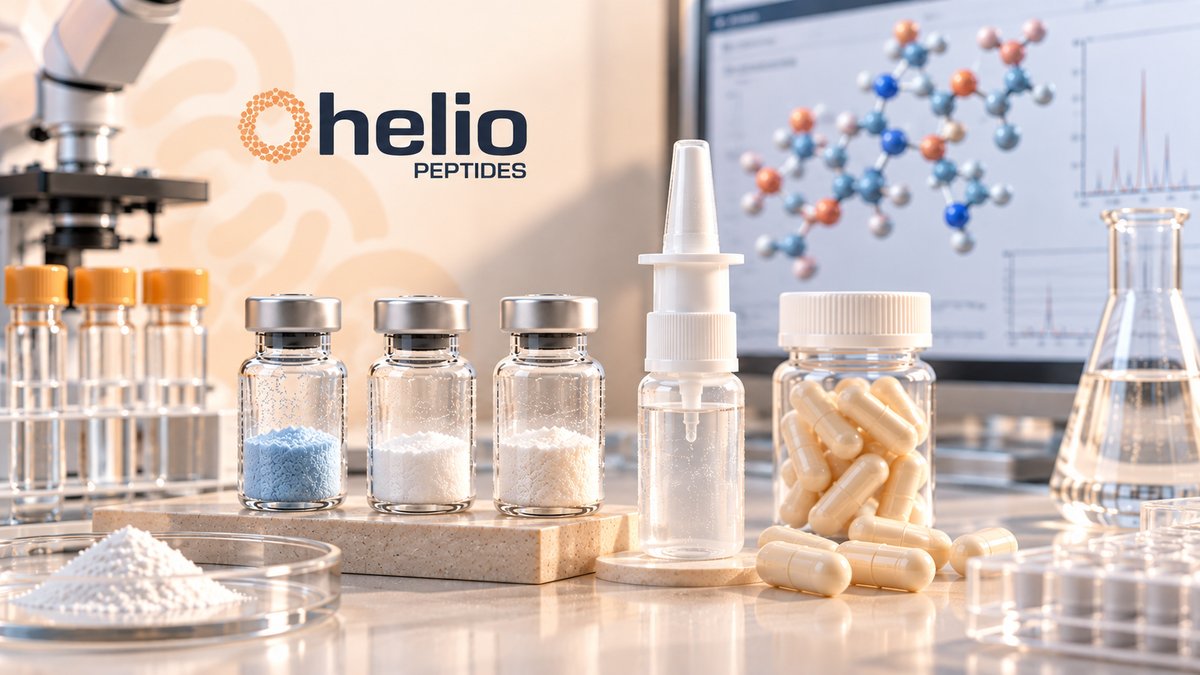
Research catalogues increasingly offer multi-peptide blends - single vials that combine two or more characterised peptides in fixed ratios. Names such as GLOW, KLOW, and BPC/TB are vendor constructs built from individual research compounds that each have their own literature. The blend itself is almost never the subject of a controlled combination trial; evidence maps back to the components.
This article explains common compositions, the experimental logic of combining pathways, how to read blend COAs, and the limits of what a blend can and cannot tell a researcher. Helio Peptides supplies these materials strictly for laboratory research. Research Use Only - not for human or animal consumption.
Direct Answer
GLOW is typically a three-peptide research blend of GHK-Cu, BPC-157, and TB-500 (often ~70 mg total, with GHK-Cu as the mass-dominant component). KLOW is commonly the same three plus KPV (often ~80 mg total). BPC/TB (or “BPC-TB”) is a two-peptide combination of BPC-157 and TB-500 without the copper peptide or KPV. Exact milligram ratios vary by supplier - always read the label and COA for the lot in hand. None of these blends is an approved drug product; each is a convenience format for laboratories studying multi-pathway tissue, matrix, or inflammation-related signalling in non-clinical systems.
Why Laboratories Use Blends
Three practical reasons drive blend use in research settings:
• Fixed ratios: every aliquot carries the same relative composition, reducing weighing error when small masses of multiple peptides would otherwise be handled separately.
• Hypothesis of complementarity: components are chosen because their individual literatures point at non-identical mechanisms (for example matrix/copper signalling vs angiogenesis-related pathways vs actin/cytoskeletal dynamics vs inflammatory peptide signalling).
The scientific cost of a blend is interpretability. If an endpoint moves, attribution to a single component is no longer straightforward without factorial controls (each peptide alone, pairs, and the full combination). Responsible experimental design either accepts the blend as a multi-factor stimulus or builds the factorial arms needed to dissect it.
GLOW: Three-Component Matrix / Repair Cluster
Across research suppliers, GLOW most often denotes:
• GHK-Cu (glycyl-L-histidyl-L-lysine copper complex) - usually the largest mass fraction.
• BPC-157 (synthetic pentadecapeptide, sequence commonly GEPPPGKPADDAGLV) - tissue-signalling and angiogenesis-related research literature.
• TB-500 (research fragment related to thymosin β-4 / actin-binding biology) - cell migration and cytoskeletal research literature.
A frequent labelled total is 70 mg (for example 50 mg GHK-Cu + 10 mg BPC-157 + 10 mg TB-500), but ratios are not universal. Helio’s GLOW 70MG and related capsule formats should be verified against the current product page and COA. GHK-Cu dominates by mass in typical recipes, so copper-peptide biology contributes heavily to any bulk property of the vial (colour, copper content assays, matrix-oriented hypotheses).
Individual component overviews remain essential. Helio’s educational content on GHK-Cu and the long-standing BPC-157 vs TB-500 comparison explain the separate evidence bases that a blend merely co-packages.
KLOW: GLOW Plus KPV
KLOW is commonly described as GLOW’s three peptides plus KPV, a tripeptide fragment related to the C-terminal region of α-melanocyte-stimulating hormone (α-MSH). Typical marketing totals are around 80 mg with KPV at ~10 mg alongside GHK-Cu, BPC-157, and TB-500 - again, confirm the specific Helio lot.
KPV is studied in inflammatory-signalling and epithelial research contexts distinct from GHK-Cu’s matrix/copper biology or TB-500’s actin-related work. Adding KPV therefore changes the mechanistic hypothesis of the blend: it is no longer only a matrix/repair cluster; it includes an explicit anti-inflammatory peptide node. Whether that addition is useful depends entirely on the experimental question.
Helio lists KLOW Blend 80MG among research blends. Treat the name as a catalogue label, not as a standardised pharmacopoeial preparation.
BPC/TB: Two-Peptide Repair Pair
The BPC-157 + TB-500 combination (sometimes called Wolverine stack in informal communities, or simply BPC/TB in catalogues) omits GHK-Cu and KPV. It is the narrowest of the common multi-peptide repair formats: two peptides with partially overlapping tissue-research literatures but different primary mechanistic emphases (BPC-157 often discussed in VEGFR2/angiogenic and cytoprotective contexts; TB-500 in actin sequestration and cell migration contexts).
Helio offers blend formats such as BPC-157 + TB-500 and related liquid-spray presentations. Standalone BPC-157 5MG and TB-500 5MG remain available for factorial designs that need single-agent arms.
Component Snapshot (Individual Mechanisms)
GHK-Cu
Copper(II) complex of the tripeptide GHK. Studied for extracellular matrix gene expression, copper delivery to enzymes, and broad transcriptomic effects in cell systems. CAS and copper stoichiometry matter for analytical verification - a “GHK-Cu” peak on HPLC is not the same as free GHK plus free copper unless the complex is confirmed.
BPC-157
Fifteen-residue synthetic peptide derived from a gastric protein sequence. Extensive preclinical literature on tissue injury models, angiogenesis-related signalling, and nitric oxide pathway interactions. Stable relative to many peptides in harsh environments in published work - still verify each research lot.
TB-500
Research material related to the active region of thymosin β-4, studied for actin binding, cell migration, and wound-model endpoints. Sequence length and fragment definition should match the COA; “TB-500” as a catalogue name can refer to specific synthetic fragments rather than full-length thymosin β-4.
KPV
Tripeptide (Lys-Pro-Val) associated with α-MSH C-terminal biology. Investigated in inflammation and barrier-function research. Mechanistically distinct from the other three, which is why its presence defines KLOW versus GLOW in many catalogues.
How to Read a Blend COA
A blend COA should ideally identify each component, report purity or assay for each, and state the labelled amounts. Minimum checks:
• Lot number on vial matches COA.
• Each peptide’s identity (mass or sequence-consistent data) is stated, not only a single “blend purity” number.
• Labelled milligrams per component sum to the vial total within analytical tolerance.
• Appearance and any copper-related notes (for GHK-Cu blends) are consistent with expectation.
If the COA only gives a single aggregate purity without resolving components, the laboratory’s ability to interpret multi-pathway results is weaker. Prefer suppliers who resolve the blend analytically. Helio’s All Certificates page is the starting point for batch documents, including GLOW and KLOW entries.
Factorial Design Thinking
When the scientific goal is mechanism, a full factorial (or at least main-effects) design is more informative than blend-only treatment:
• Vehicle control
• Each single peptide at the same mass used in the blend
• Key pairs (e.g., BPC+TB, GHK-Cu+BPC)
• Full blend
That structure reveals synergy, additivity, or antagonism. Without it, a positive blend result is a multi-factor observation - useful as a screening hit, incomplete as a mechanistic conclusion. Screening with a blend then dissecting hits with single agents is a valid staged strategy.
Formats: Vials, Capsules, Sprays
Blends appear as lyophilized vials (most common for GLOW/KLOW), capsules (e.g., GLOW capsule counts), and dual liquid sprays (e.g., BPC/TB spray). For general format trade-offs, see Helio’s capsules vs liquid sprays vs vials discussion.
What Blends Are Not
• Not standardised pharmacopoeial preparations - ratios are supplier-defined.
• Not proven combination drugs - combination RCTs for these catalogue blends are not the evidence base.
• Not substitutes for single-agent characterisation when mechanism is the question.
• Not for human or veterinary exposure under RUO supply terms.
Research Applications
• Multi-pathway screening in cell migration, matrix, or inflammation models.
• Method development for multi-analyte HPLC/LC-MS of co-lyophilized peptides.
• Training on COA literacy for complex research products.
• Pilot studies before committing to full factorial single-agent work.
• Comparative logistics studies: blend workflow vs separate vials under the same endpoint battery.
Compliance
All Helio blends are Research Use Only. They are not intended to diagnose, treat, cure, or prevent disease. Marketing language that implies human recovery, anti-aging therapy, or clinical stacking is incompatible with RUO supply. Laboratory documentation should describe components, lots, and non-clinical endpoints accurately.
Mass Balance and Ratio Transparency
Because GHK-Cu often dominates GLOW and KLOW by mass, a 70 mg or 80 mg vial is not “equal parts” biology. Copper-peptide content drives bulk copper assays and can dominate spectroscopic or colorimetric observations. When comparing two suppliers’ GLOW products, compare component milligrams first, then total vial mass. A 70 mg vial with 50/10/10 is not the same experimental input as a 70 mg vial with a different split.
If a study designs needs equimolar component exposure, a pre-mixed mass-ratio blend is the wrong tool. Separate vials and independent weighing are required. Blends optimise convenience for fixed-ratio screening, not for arbitrary stoichiometric designs.
Stability Interactions in Co-Lyophilized Products
Co-lyophilization places different sequences in the same solid matrix. In principle, residual moisture, pH of the pre-lyophilization solution, and freeze-drying cycle parameters can affect each peptide differently.
Copper-containing blends introduce redox and chelation chemistry that pure organic peptides lack. Use appropriate containers and avoid unnecessary metal contamination from spatulas or water sources when preparing analytical samples.
Reporting Standards for Blend Experiments
Calling a treatment “GLOW” without composition is not reproducible. If the blend is used only as a screening cocktail, say so; if mechanistic claims are made, show the factorial data that support them.
Negative controls matter. A vehicle that dissolves a copper peptide blend may need to match ionic strength and pH of the active arm.
Connecting Blends to Helio’s Wider Catalogue
Researchers who start with a blend and then need single agents can source BPC-157, TB-500, GHK-Cu, and related materials as separate SKUs from the same supplier, simplifying COA style and shipping logistics. Liquid spray and capsule presentations of related combinations exist for format-specific hypotheses.
Frequently Asked Questions
Q: Is GLOW a single molecule?
No. It is a multi-peptide mixture (typically GHK-Cu + BPC-157 + TB-500).
Q: What is the difference between GLOW and KLOW?
KLOW usually adds KPV to the GLOW three-peptide set. Confirm exact mg amounts on the product COA.
Q: Can I attribute a blend result to BPC-157 alone?
Not rigorously, unless single-agent and factorial controls were included.
Q: Where do I find blend COAs?
See All Certificates for GLOW, KLOW, BPC/TB, and component vials.
Q: Should I buy the blend or separate vials?
Use the blend for fixed-ratio multi-pathway screening; use separates when you need to vary ratios or run single-agent arms.
Mass Balance and Ratio Transparency
Because GHK-Cu often dominates GLOW and KLOW by mass, a 70 mg or 80 mg vial is not “equal parts” biology. Copper-peptide content drives bulk copper assays and can dominate spectroscopic or colorimetric observations. When comparing two suppliers’ GLOW products, compare component milligrams first, then total vial mass. A 70 mg vial with 50/10/10 is not the same experimental input as a 70 mg vial with a different split.
If a study designs needs equimolar component exposure, a pre-mixed mass-ratio blend is the wrong tool. Separate vials and independent weighing are required. Blends optimise convenience for fixed-ratio screening, not for arbitrary stoichiometric designs.
Stability Interactions in Co-Lyophilized Products
Co-lyophilization places different sequences in the same solid matrix. In principle, residual moisture, pH of the pre-lyophilization solution, and freeze-drying cycle parameters can affect each peptide differently.
Copper-containing blends introduce redox and chelation chemistry that pure organic peptides lack. Use appropriate containers and avoid unnecessary metal contamination from spatulas or water sources when preparing analytical samples.
Reporting Standards for Blend Experiments
Calling a treatment “GLOW” without composition is not reproducible. If the blend is used only as a screening cocktail, say so; if mechanistic claims are made, show the factorial data that support them.
Negative controls matter. A vehicle that dissolves a copper peptide blend may need to match ionic strength and pH of the active arm.
Connecting Blends to Helio’s Wider Catalogue
Researchers who start with a blend and then need single agents can source BPC-157, TB-500, GHK-Cu, and related materials as separate SKUs from the same supplier, simplifying COA style and shipping logistics. Liquid spray and capsule presentations of related combinations exist for format-specific hypotheses.
Related Helio Research Materials
GLOW 70MG · KLOW Blend 80MG · BPC-157 + TB-500 · BPC-157 5MG · TB-500 5MG · GHK-Cu 50MG · All Certificates · Research Blog
Research Use Only. Not for human or animal consumption. No therapeutic, diagnostic, or disease claims are made. Information is educational for qualified laboratory personnel.
Helio Peptides supplies research materials made in the USA, third-party tested to 99%+ purity, and shipped with a Certificate of Analysis. Browse research materials →

