
GHK-Cu Dissolvable Strips
About GHK-Cu Dissolvable Strips
GHK-Cu, also designated Copper Tripeptide-1, is a copper(II)-chelated complex of the naturally occurring tripeptide glycyl-L-histidyl-L-lysine (Gly-His-Lys, GHK). The GHK sequence was first isolated from human plasma, and its high affinity for divalent copper ions gives rise to the blue-tinted 1:1 complex catalogued in PubChem under CID 71587328. In research settings the compound is studied as a model system for copper transport, extracellular-matrix biology, and copper-dependent enzymatic activity.
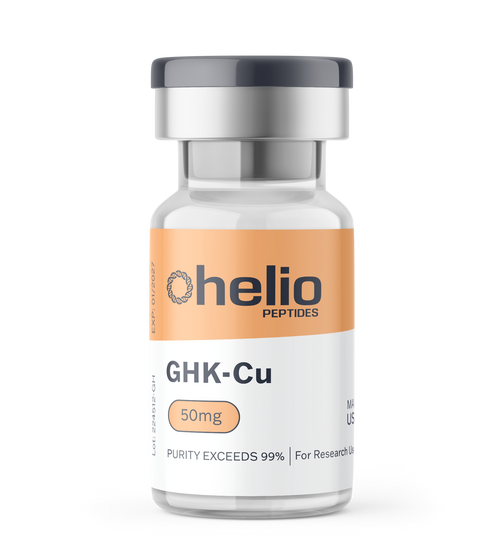
Supplied as a lyophilized powder in a 50mg vial, Helio's GHK-Cu is intended strictly for in vitro and preclinical laboratory investigation. Reported literature explores its interaction with fibroblast cultures, collagen and glycosaminoglycan expression, and copper-signaling pathways. All material is offered for Research Use Only and is not for human or veterinary use.
Format: supplied as dissolvable oral strips (30 per box) — a fast, non-invasive research format. Exact per-strip potency is printed on the packaging.
Research use only — not for human or animal consumption. Per-batch documentation is provided with the material.
GHK-Cu is a naturally occurring copper-binding tripeptide studied extensively in skin, tissue-remodeling, and regenerative research.
Supplied as dissolvable oral strips — 30 strips per box — for fast, consistent, non-invasive handling in the research setting. Exact per-strip potency is printed on the packaging.
Every batch is independently tested by an ISO 17025-accredited laboratory to ≥99% purity, with a certificate of analysis on file for its exact lot.
For research use only. Not for human or veterinary consumption, diagnosis, or treatment.
Specifications
- MaterialGHK-Cu Dissolvable Strips
- Also searched asGHK Cu, GHKcu, Copper Peptide, GHK Copper
- Research AreaSkin & Cosmetic Research
- PresentationDissolvable Strips
- CAS Number89030-95-5
- Molecular FormulaC14H24CuN6O4
- Molecular Weight403.92 g/mol
- TypeCopper-bound tripeptide complex
- Receptor / TargetCopper-dependent enzymes; matrix and gene-expression modulation (in vitro)
- PubChem CID71587328 →
Gly-His-Lys (copper(II) complex)
- Purity (HPLC)≥99%
- Identity (MS)Confirmed to specification
- TestingAccredited (ISO 17025) third-party laboratory
- DocumentationPer-batch COA →
Published in vitro work reports that GHK and its copper complex can influence fibroblast behavior and the expression of extracellular-matrix components such as collagen and glycosaminoglycans. Broad gene-expression profiling studies have described GHK-Cu as modulating large numbers of genes in cultured cells, prompting continued interest as a research tool for tissue-remodeling pathways.
The copper-binding property is central to much of the reported activity, and researchers frequently study GHK-Cu as a defined-stoichiometry model for delivering copper into cellular systems. Findings are preclinical and experimental; no human efficacy conclusions are drawn.
The GHK tripeptide was first identified in the 1970s by Loren Pickart as a factor in human plasma, and its strong affinity for copper(II) led to characterization of the GHK-Cu complex. It has since become a widely referenced subject in matrix-biology and copper-signaling research.
- Pickart L, Margolina A. Regenerative and Protective Actions of the GHK-Cu Peptide in the Light of the New Gene Data. Int J Mol Sci. 2018;19(7):1987.
- Pickart L. The human tri-peptide GHK and tissue remodeling. J Biomater Sci Polym Ed. 2008;19(8):969-988.
- PubChem Compound Summary for CID 71587328, Copper Peptide GHK-Cu. National Library of Medicine.
View compound profile on NIH PubChem →
Cited literature refers to laboratory and preclinical research. This material is supplied strictly for research use only and is not intended to diagnose, treat, cure, or prevent any disease.
Are these research materials third-party tested?
Yes — every batch is analysed by an accredited (ISO 17025) independent laboratory using HPLC and mass spectrometry, with a per-batch Certificate of Analysis.
What purity are the materials?
Materials are verified to 99%+ HPLC purity. Any batch that does not meet the threshold is not released.
Do you provide a Certificate of Analysis (COA)?
Yes. Per-batch COA documentation is provided and is traceable by lot number.
Where do you ship from?
Materials are shipped from the USA in discreet, protective packaging.
Are these products for human use?
No. All materials are sold strictly for laboratory research use only — not for human or animal consumption, diagnosis, treatment, or prevention of any disease.
More Skin & Cosmetic Research materials
RESEARCH USE ONLY · NOT FOR HUMAN OR VETERINARY USE · 21+

