
Glutathione Dissolvable Strips
About Glutathione Dissolvable Strips
Glutathione (reduced form, GSH) is a gamma-linked tripeptide of glutamate, cysteine, and glycine and the most abundant low-molecular-weight thiol antioxidant in mammalian cells. With the molecular formula C10H17N3O6S and a molecular weight of 307.32 g/mol (CAS 70-18-8), it is present at millimolar concentrations in healthy tissue and participates in an unusually broad range of biochemical processes. The unusual gamma-glutamyl bond between glutamate and cysteine distinguishes it structurally from standard peptides.
Research on glutathione spans redox homeostasis, reactive-oxygen-species neutralization, xenobiotic and drug detoxification via conjugation, protein disulfide regulation, and immune-cell function. It serves as the central substrate of the glutathione peroxidase and glutathione S-transferase enzyme families and cycles between reduced (GSH) and oxidized (GSSG) states to maintain cellular redox balance. This reduced L-glutathione is supplied for laboratory research use only.
Format: supplied as dissolvable oral strips (30 per box) — a fast, non-invasive research format. Exact per-strip potency is printed on the packaging.
Research use only — not for human or animal consumption. Per-batch documentation is provided with the material.
Glutathione is an endogenous tripeptide antioxidant studied broadly across cellular, detoxification, and oxidative-stress research.
Supplied as dissolvable oral strips — 30 strips per box — for fast, consistent, non-invasive handling in the research setting. Exact per-strip potency is printed on the packaging.
Every batch is independently tested by an ISO 17025-accredited laboratory to ≥99% purity, with a certificate of analysis on file for its exact lot.
For research use only. Not for human or veterinary consumption, diagnosis, or treatment.
Specifications
- MaterialGlutathione Dissolvable Strips
- Also searched asGSH, L-Glutathione
- Research AreaLongevity Research
- PresentationDissolvable Strips
- CAS Number70-18-8
- Molecular FormulaC10H17N3O6S
- Molecular Weight307.32 g/mol
- TypeEndogenous tripeptide (thiol antioxidant)
- Receptor / TargetNon-receptor; cofactor/substrate for glutathione peroxidases, glutathione S-transferases, and glutaredoxin redox systems
- PubChem CID124886 →
gamma-L-Glutamyl-L-cysteinylglycine (gamma-Glu-Cys-Gly)
- Purity (HPLC)≥99%
- Identity (MS)Confirmed to specification
- TestingAccredited (ISO 17025) third-party laboratory
- DocumentationPer-batch COA →
Glutathione is among the most extensively studied endogenous small molecules in biochemistry. Research literature documents its function as the principal intracellular thiol buffer, its role as substrate for glutathione peroxidase in hydrogen-peroxide detoxification, its conjugation reactions with electrophiles via glutathione S-transferases, and its participation in protein S-glutathionylation as a post-translational redox modification.
The reduced form (GSH) is readily oxidized to the disulfide GSSG, and maintaining a high GSH/GSSG ratio is a widely used experimental index of cellular redox status. Material is provided as a research reagent only.
Glutathione was first isolated in 1888 and structurally characterized in the 1920s and 1930s, with Frederick Gowland Hopkins among the early investigators who identified it as a widespread cellular constituent. Its gamma-glutamyl tripeptide structure and central role in cellular redox biology have since made it one of the most-studied endogenous antioxidants in biochemistry.
- Meister A, Anderson ME. Glutathione. Annu Rev Biochem. 1983;52:711-760.
- Lu SC. Glutathione synthesis. Biochim Biophys Acta. 2013;1830(5):3143-3153.
- Forman HJ, Zhang H, Rinna A. Glutathione: overview of its protective roles, measurement, and biosynthesis. Mol Aspects Med. 2009;30(1-2):1-12.
- PubChem Compound Summary for CID 124886, Glutathione. National Center for Biotechnology Information.
View compound profile on NIH PubChem →
Cited literature refers to laboratory and preclinical research. This material is supplied strictly for research use only and is not intended to diagnose, treat, cure, or prevent any disease.
Are these research materials third-party tested?
Yes — every batch is analysed by an accredited (ISO 17025) independent laboratory using HPLC and mass spectrometry, with a per-batch Certificate of Analysis.
What purity are the materials?
Materials are verified to 99%+ HPLC purity. Any batch that does not meet the threshold is not released.
Do you provide a Certificate of Analysis (COA)?
Yes. Per-batch COA documentation is provided and is traceable by lot number.
Where do you ship from?
Materials are shipped from the USA in discreet, protective packaging.
Are these products for human use?
No. All materials are sold strictly for laboratory research use only — not for human or animal consumption, diagnosis, treatment, or prevention of any disease.
More Longevity Research materials
 ✓ ≥99% View COA ›
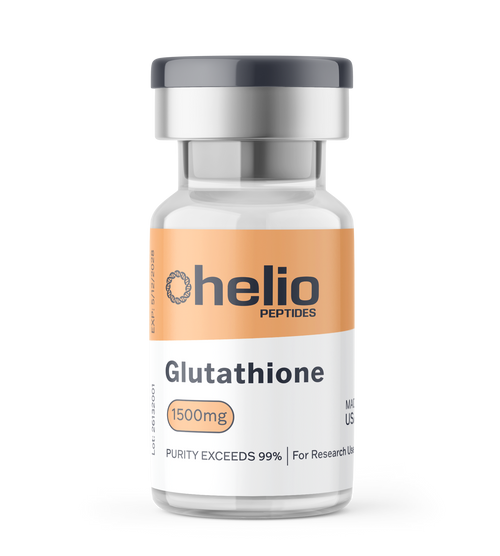
Glutathione 1500MG Research Vial – Reduced L-Glutathione (GSH) | Third-Party Tested
RESEARCH USE ONLY · NOT FOR HUMAN OR VETERINARY USE · 21+

