PT-141 (Bremelanotide) 10MG Research Vial - Melanocortin Receptor Agonist | Third-Party Tested
PT-141 (Bremelanotide) 10MG Research Vial - Melanocortin Receptor Agonist | Third-Party Tested
Couldn't load pickup availability
A single-component research material supplied for controlled research environments. Suitable for studies involving mitochondrial-derived peptide characterization and method development in model systems.
Free Shipping
On $100+
250K+ Peptides
Delivered
USA Made
& Sourced
Research Use Only
All products are intended solely for laboratory research and are not for human or animal consumption. By purchasing, the buyer agrees to use these products in compliance with all applicable laws.


PT-141 Research That Actually Gets Used
Melanocortin receptor pharmacology is one of the most actively investigated areas of neuroendocrine research. The compounds used to probe this system need to be precisely characterised - correct sequence, confirmed molecular identity, documented batch. Most research compound suppliers can't demonstrate any of that.
Helio Peptides operates differently.
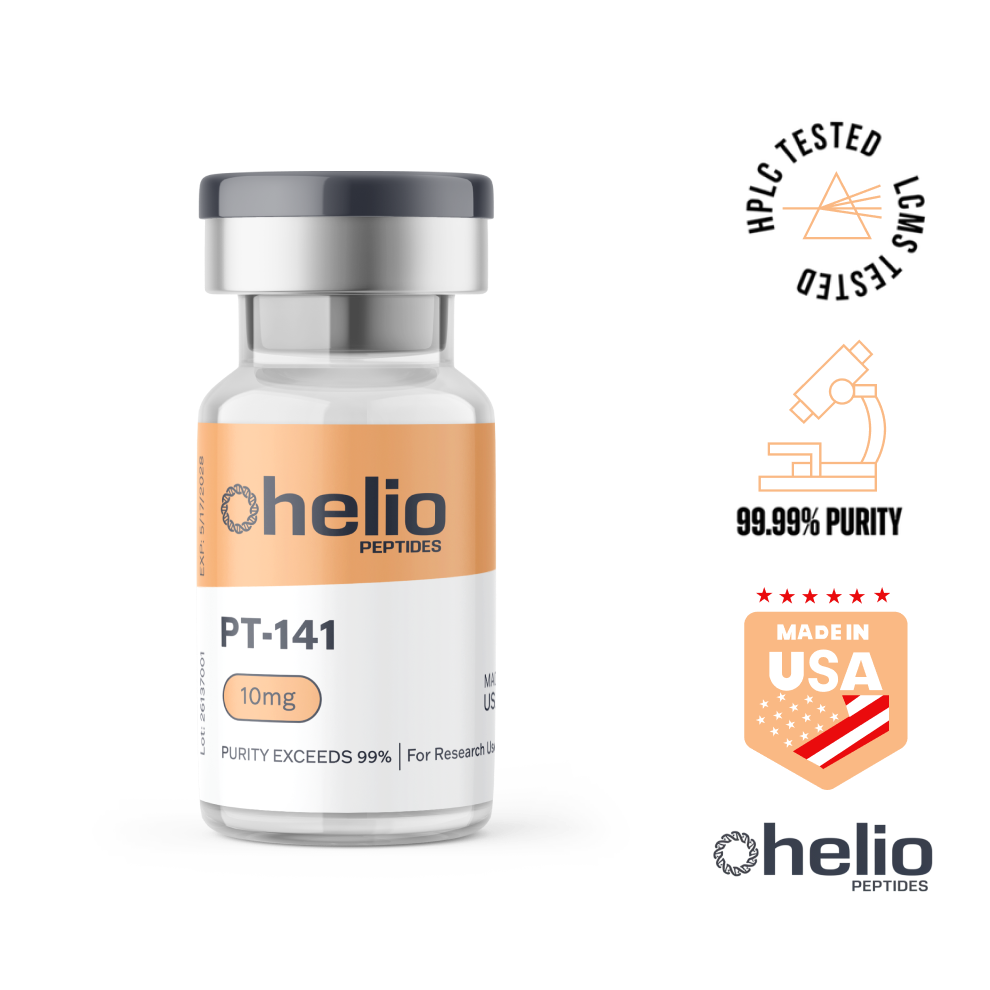
Every vial of PT-141 goes through independent third-party testing at an ISO 17025-accredited laboratory before it ships - identity confirmed by HPLC, molecular weight verified by mass spectrometry, and assay content confirmed at the labelled 10MG. The Certificate of Analysis is available on request for every batch. Not selectively. Every batch.
PT-141 - also known as Bremelanotide - is a synthetic cyclic heptapeptide and potent agonist of the melanocortin receptor family, developed from the earlier melanocortin agonist Melanotan II. It is one of the most studied melanocortin receptor agonists in the preclinical and clinical research literature, with a documented pharmacological profile across MC1R, MC3R, MC4R, and MC5R receptor subtypes. At $39.95 per vial - or $35.96 in a pack of ten - it is among the most cost-accessible and thoroughly documented melanocortin research compounds available from a US-based, ISO-accredited tested supplier. Researchers working across the melanocortin receptor system may also be investigating our Melanotan II Vial - the linear precursor peptide from which PT-141 was developed - alongside PT-141 in comparative receptor subtype selectivity studies.
What Makes This Vial Different
PT-141 is available from multiple research compound suppliers. The meaningful question is not availability - it's verification. Here's what separates the Helio Peptides PT-141 10MG vial:
Third-party tested at an ISO 17025-accredited lab. The laboratory conducting the testing has been independently verified for technical accuracy and measurement reliability. Every Helio Peptides PT-141 batch is tested at such a facility. Full batch documentation is available in our Certificate of Analysis.
USA manufactured. Synthesised by solid-phase peptide synthesis (SPPS) in a controlled US-based facility under strict manufacturing standards. Not imported bulk material relabelled domestically - manufactured, tested, and dispatched from the United States.
Sequence and structure confirmed by mass spectrometry. PT-141 is a cyclic heptapeptide - its cyclic structure (formed by a lactam bridge between Asp and Lys residues) is confirmed at every batch by MS. Cyclic peptide synthesis is more technically demanding than linear synthesis - confirmation of cyclisation and the correct disulfide-equivalent bridge is essential for receptor activity.
Lyophilised for stability. Supplied as lyophilised powder - substantially more stable than liquid formats in shipping and storage. Cold-chain packaging included on every order.
Cost-accessible with a bulk option. $39.95 single vial. $35.96 per vial in a pack of ten. Competitive pricing for ISO-accredited tested PT-141 from a US supplier with same-day dispatch.
What Is PT-141 (Bremelanotide)?
PT-141, formally known as Bremelanotide, is a synthetic cyclic heptapeptide melanocortin receptor agonist developed as a metabolite of Melanotan II (MT-II). Its full chemical name is cyclo(-Nle-cyclo[Asp-His-D-Phe-Arg-Trp-Lys])2 with the systematic name (3S,6R,9S,12S,15R,18S,21R)-15-(4-aminobutyl)-9-benzyl-6-[3-(diaminomethylideneamino)propyl]-12-(1H-imidazol-5-ylmethyl)-3-(2-methylpropyl)-2,5,8,11,14,17,20-heptaoxo-18-(propan-2-yl)-1,4,7,10,13,16,19-heptazacyclotricosane-21-carboxamide.
PT-141 was identified as an active metabolite when Melanotan II was metabolised in vivo to the des-glycine form. This metabolite retained melanocortin receptor agonist activity while exhibiting a distinct pharmacological profile from the parent compound. Unlike Melanotan II - which is a linear peptide - PT-141 is a cyclic lactam structure, conferring greater metabolic stability and a different receptor subtype selectivity profile.
PT-141 acts as an agonist at multiple melanocortin receptor subtypes - specifically MC1R, MC3R, MC4R, and MC5R - with particularly well-characterised activity at MC4R and MC3R. The melanocortin system is a neuroendocrine signalling network governing a remarkably broad range of physiological functions including pigmentation (MC1R), energy homeostasis and body weight (MC3R, MC4R), central nervous system autonomic pathways (MC4R), and exocrine gland function (MC5R). PT-141's pan-melanocortin receptor activity makes it a versatile pharmacological tool for studying melanocortin receptor biology across multiple organ systems and physiological contexts.
PT-141 differs from Melanotan II primarily in its cyclic structure and consequent receptor selectivity profile. Our Melanotan II Vial is the linear parent compound - active at MC1R, MC3R, MC4R, and MC5R with a slightly different potency distribution across receptor subtypes. Researchers conducting comparative melanocortin pharmacology will frequently work with both PT-141 and Melanotan II in parallel to characterise receptor subtype selectivity, structural determinants of binding affinity, and the pharmacodynamic consequences of cyclic versus linear peptide presentation at melanocortin receptors.
|
"PT-141 (Bremelanotide) is one of the most comprehensively studied melanocortin receptor agonists in the preclinical literature - with documented activity across MC1R, MC3R, MC4R, and MC5R, a well-characterised pharmacokinetic profile, and a published clinical research record. Its cyclic structure, metabolic stability, and pan-MCR activity make it indispensable for any laboratory conducting systematic melanocortin receptor pharmacology." - Melanocortin research community on PT-141 as a reference standard |
Research Applications
PT-141 has been investigated across a broad range of research directions in melanocortin receptor pharmacology, neuroendocrinology, and autonomic nervous system research. All applications described below are for controlled laboratory environments only. This product is for research use only and is not for human or animal consumption.
Melanocortin Receptor Pharmacology
The foundational research application for PT-141 is systematic characterisation of melanocortin receptor subtypes. The melanocortin receptor family comprises five G-protein-coupled receptors (MC1R–MC5R) with distinct tissue distributions, endogenous ligand profiles, and physiological functions. PT-141's activity across MC1R, MC3R, MC4R, and MC5R - combined with its well-defined pharmacokinetic profile - makes it a reference compound for melanocortin receptor binding assays, signal transduction studies, and receptor selectivity characterisation in both heterologous expression systems (HEK293, CHO cells) and native tissue preparations.
Research in this area includes cAMP accumulation assays (MCR signalling is primarily Gs-coupled), receptor internalisation and trafficking studies, competitive binding assays comparing PT-141 to endogenous melanocortin peptides (α-MSH, β-MSH, γ-MSH, ACTH) and to novel synthetic MCR ligands, and characterisation of species-specific receptor pharmacology across murine, primate, and human MCR sequences.
MC4R and Central Nervous System Research
MC4R is expressed throughout the central nervous system - particularly in hypothalamic nuclei governing autonomic function, energy balance, and reproductive physiology. PT-141's well-characterised MC4R agonist activity makes it a primary tool for studying hypothalamic MC4R signalling pathways in neuroendocrine research. Published studies have examined PT-141's effects on hypothalamic neuronal activity, autonomic outflow modulation, and the central regulation of peripheral physiological responses through MC4R-expressing neuronal populations. Researchers investigating MC4R signalling in the context of feeding behaviour and energy homeostasis may also be working with our MOTS-c 10MG Vial or our AOD-9604 Vial in complementary metabolic research programmes.
MC3R and Energy Homeostasis Research
MC3R - expressed in hypothalamic nuclei, limbic structures, and peripheral metabolic tissues - is studied for its role in energy homeostasis, adipose tissue biology, and the regulation of energy expenditure. PT-141's MC3R agonist activity has made it a tool for studying the contribution of MC3R signalling to appetite regulation, adiposity phenotypes, and the interaction between the melanocortin system and leptin/insulin signalling pathways in murine metabolic models.
Research examining the melanocortin system's contribution to metabolic syndrome and obesity phenotypes frequently uses PT-141 alongside melanocortin receptor antagonists to establish the directional contribution of MC3R and MC4R signalling to observed metabolic outcomes. Researchers in this domain may also be examining our SLU-PP-332 5MG Vial - the pan-ERR agonist exercise mimetic - for complementary transcriptional metabolic research running alongside melanocortin pharmacology studies.
MC1R and Pigmentation Research
MC1R is expressed predominantly on melanocytes and governs the switch between eumelanin (brown/black) and phaeomelanin (red/yellow) pigment synthesis in response to α-MSH stimulation. PT-141's MC1R agonist activity has made it a tool for studying melanocyte biology, pigmentation pathway regulation, and MC1R signal transduction in cell culture and murine model systems. This includes research on MC1R-mediated cAMP signalling in B16 melanoma cells, MC1R's role in photoprotection responses to UV irradiation, and the characterisation of MC1R variants associated with pigmentation phenotypes. Researchers studying pigmentation biology may also be working with our Melanotan II Vial in parallel MC1R agonist studies, and with our GHK-Cu 50MG Vial in complementary melanocyte biology and skin research programmes.
Autonomic Nervous System and Cardiovascular Research
PT-141 has been studied in the context of autonomic nervous system modulation - specifically the cardiovascular effects associated with melanocortin receptor agonism in central autonomic control centres. Published research has examined PT-141's effects on blood pressure, heart rate, and autonomic tone in murine models, characterising the cardiovascular pharmacodynamics of systemic melanocortin receptor agonism. This research is relevant to understanding the autonomic side effect profile of melanocortin compounds and to the broader study of central-peripheral autonomic crosstalk through hypothalamic MC4R-expressing neuronal circuits.
Comparative Melanocortin Agonist Research: PT-141 vs Melanotan II
A significant application of PT-141 in research settings is its use in systematic comparative studies alongside our Melanotan II Vial. The structural relationship between the two compounds - PT-141 as the cyclic des-glycine metabolite of the linear Melanotan II - makes direct comparison valuable for characterising how cyclisation affects receptor subtype selectivity, binding kinetics, metabolic stability, and pharmacodynamic profile across the melanocortin receptor family. Studies comparing PT-141 and Melanotan II have been published across multiple pharmacological endpoints, making the availability of both compounds from a single ISO-tested source a practical advantage for research programmes building systematic melanocortin receptor pharmacology datasets.
Product Specifications
|
Specification |
Detail |
|
Peptide Name |
PT-141 (Bremelanotide) |
|
Also Known As |
Bremelanotide, cyclo(-Nle-cyclo[Asp-His-D-Phe-Arg-Trp-Lys]) |
|
CAS Number |
189691-06-3 |
|
Molecular Formula |
C₅₀H₆₈N₁₄O₁₀ |
|
Molecular Weight |
1,025.17 g/mol |
|
Structure |
Cyclic heptapeptide - lactam bridge between Asp and Lys residues |
|
Amino Acid Count |
7 amino acids (cyclic lactam structure) |
|
Receptor Targets |
MC1R, MC3R, MC4R, MC5R (pan-melanocortin receptor agonist) |
|
MC4R Activity |
Primary CNS melanocortin receptor target - hypothalamic autonomic pathways |
|
MC1R Activity |
Melanocyte pigmentation pathway - eumelanin/phaeomelanin switch |
|
Vial Size |
10MG lyophilised powder |
|
Synthesis Method |
Solid-phase peptide synthesis (SPPS) with cyclisation |
|
Purity |
≥99% - HPLC and mass spectrometry confirmed |
|
Testing Facility |
ISO 17025-accredited third-party laboratory |
|
Manufacture |
USA - controlled facility |
|
Short-Term Storage |
Refrigerate at 4°C (39°F) - days to weeks |
|
Long-Term Storage |
Freeze at -80°C (-112°F) - months to years |
|
Reconstitution |
Bacteriostatic water or sterile water - research use only |
|
Solubility |
Soluble in water; freely soluble in dilute acetic acid |
|
Price (Single) |
$39.95 |
|
Price (Pack of 10) |
$35.96 per vial - 10% saving |
|
Intended Use |
Laboratory research only. Not for human or animal consumption. |
Purity Testing & Certificate of Analysis
Every batch of Helio Peptides PT-141 is independently tested before release. Not sampled - every batch. Testing is conducted by an ISO 17025-accredited third-party laboratory using three confirmatory analytical methods:
-
HPLC (High-Performance Liquid Chromatography): Separates and quantifies the compound against certified reference standards - confirms identity, detects synthesis by-products, and verifies purity at ≥99%
-
Mass Spectrometry (MS): Confirms the exact molecular mass at 1,025.17 g/mol and verifies the cyclic lactam structure - rules out linear (uncyclised) synthesis product, truncated sequences, and structural artefacts
-
Assay / Content Testing: Confirms the exact quantity of active PT-141 per vial matches the labelled 10MG
The COA for any specific batch is available on request. Email info@heliopeptides.com with your order number and batch details, or use the live chat on site. For a full explanation of COA methodology, how to interpret HPLC chromatograms, and why ISO 17025 laboratory accreditation matters, visit our Certificate of Analysis and Testing page. Reconstitution guidance and laboratory handling protocols are covered on our FAQ page.
How to Reconstitute PT-141
PT-141 is supplied as a lyophilised powder. It is soluble in water and freely soluble in dilute acetic acid - for vials that require additional solubility assistance, a small volume of dilute acetic acid (0.1–1%) followed by dilution in sterile water or buffer is the standard approach in published research protocols.
-
Allow the vial to reach room temperature before opening - prevents moisture condensation on the peptide
-
Draw the required volume of bacteriostatic water or sterile water for injection using a sterile needle and syringe
-
Inject the diluent slowly along the inner wall of the vial - not directly onto the lyophilised cake
-
Gently swirl in a circular motion until fully dissolved. If resistance is encountered, a small volume of 0.1% acetic acid can be added first, followed by dilution to the target volume in sterile water
-
Inspect the solution - it should be clear and colourless. Discard if cloudiness or particulates are visible
-
Store reconstituted solution at 4°C and use within 2–4 weeks, or aliquot and freeze at -80°C
For in vitro receptor binding and cell-based assays, further dilute the reconstituted stock in appropriate assay buffer (typically PBS or HEPES-buffered saline, pH 7.4) to working concentrations. For in vivo murine studies, subcutaneous or intraperitoneal administration in sterile saline vehicle has been used in published protocols. For complete reconstitution and handling guidance, visit our FAQ page.
Storage Guidelines
PT-141's cyclic structure confers greater metabolic stability than linear peptides of comparable size, but proper storage is still essential to maintain research-grade integrity.
-
On delivery: refrigerate immediately - do not leave at room temperature for extended periods
-
Short-term (days to weeks): refrigerate at 4°C, away from direct light, in original or opaque packaging
-
Long-term (months to years): freeze at -80°C - optimal for extended stability of the cyclic peptide structure
-
Avoid repeated freeze-thaw cycles: aliquot into single-use volumes before freezing if the vial will be accessed across multiple experimental sessions
-
Reconstituted solution: stable at 4°C for 2–4 weeks. Freeze aliquots at -80°C for longer storage
-
pH sensitivity: maintain near-neutral pH in storage solutions - avoid extremes of pH that can hydrolyse the lactam bridge or deamidate residues
Helio Peptides ships all vials with cold-chain packaging. Contact info@heliopeptides.com or call 1-855-435-4633 immediately if you have any concerns about vial condition upon arrival.
The Dosing Breakdown
|
Format |
Detail |
|
Vial size |
10MG lyophilised PT-141 (Bremelanotide) |
|
Single vial price |
$39.95 |
|
Pack of 10 price |
$35.96 per vial - 10% saving - $359.60 total |
|
Total in pack of 10 |
100MG PT-141 across 10 vials |
|
Best for |
Melanocortin receptor pharmacology research, MC4R/MC3R/MC1R studies, comparative melanocortin agonist programmes |
The 10MG vial provides sufficient material for extensive in vitro receptor characterisation work across multiple concentration ranges, and for multi-dose in vivo murine studies when concentration-response relationships are being established. For research programmes requiring consistent batch-matched supply across extended experimental timelines, the pack of ten at $35.96 per vial is the most cost-efficient format. For institutional or wholesale pricing, contact our wholesale team directly.
How PT-141 Fits the Helio Lineup
When to choose PT-141: Your research involves melanocortin receptor pharmacology, MC4R or MC3R signalling studies, central autonomic regulation research, MC1R pigmentation biology, or comparative melanocortin agonist programmes requiring a cyclic lactam structure reference compound.
When to also consider Melanotan II: Our Melanotan II (MT-II) Vial is the linear parent compound from which PT-141 is derived. Comparative studies between PT-141 (cyclic) and Melanotan II (linear) are fundamental to structure-activity relationship research in melanocortin pharmacology. Both compounds are available from Helio Peptides with full ISO-accredited COA documentation.
When to also consider Thymosin Alpha 1: For multi-peptide research programmes spanning melanocortin and immune biology, our Thymosin Alpha 1 5MG Vial covers TLR pathway modulation and T-cell differentiation research - a complementary research thread in neuroimmunology programmes examining melanocortin-immune system interactions.
When to also consider BPC-157: Researchers examining tissue repair endpoints alongside melanocortin receptor pharmacology will find our BPC-157 Vial relevant - BPC-157 has documented interactions with dopaminergic and serotonergic systems that make it of interest in neuromodulation research alongside MCR compounds.
When to also consider GHK-Cu: For research programmes examining melanocyte biology and skin-related peptide pharmacology alongside PT-141's MC1R research applications, our GHK-Cu 50MG Vial covers collagen synthesis, skin matrix remodelling, and melanocyte-related wound healing models.
When to also consider KPV: Our KPV 10MG Vial is the C-terminal tripeptide of α-MSH - the endogenous ligand for melanocortin receptors. KPV retains anti-inflammatory activity through a mechanism that partially overlaps with the broader melanocortin system, making it a related compound of interest for researchers studying melanocortin biology and inflammation.
When to also consider MOTS-c: For research programmes combining melanocortin metabolic research with mitochondrial biology, our MOTS-c 10MG Vial covers AMPK-mediated metabolic regulation - a complementary pathway to MC3R/MC4R-mediated energy homeostasis.
Shipping & Fulfilment
|
Detail |
Policy |
|
Same-Day Dispatch |
Orders placed before the daily cut-off ship same day from our US facility |
|
Free Shipping |
On all orders over $100 |
|
Domestic Delivery |
1–3 business days within the USA |
|
Cold-Chain Packaging |
All vials ship with cold-chain protection to maintain peptide integrity in transit |
|
Payment Methods |
Credit/debit card (3D Secure), bank transfer, ETH, BTC, USDC |
|
Customer Service |
1-855-435-4633 · info@heliopeptides.com · Live Chat on site |
Frequently Asked Questions
What is PT-141 (Bremelanotide) used for in research?
PT-141 is studied in controlled laboratory settings for melanocortin receptor pharmacology (MC1R, MC3R, MC4R, MC5R), central nervous system neuroendocrine signalling, hypothalamic autonomic pathway research, MC1R-mediated pigmentation biology, MC3R/MC4R energy homeostasis models, and comparative melanocortin agonist studies. Research use only - not for human or animal consumption.
What is the difference between PT-141 and Melanotan II?
PT-141 (Bremelanotide) is a cyclic heptapeptide - it was identified as the active des-glycine metabolite of Melanotan II and formed into a cyclic lactam structure. Our Melanotan II Vial is a linear peptide. The cyclic structure of PT-141 confers different metabolic stability, receptor subtype selectivity, and pharmacokinetic profile compared to the linear Melanotan II parent compound. Comparative studies between the two are a well-established design in melanocortin receptor structure-activity relationship research.
Which melanocortin receptors does PT-141 activate?
PT-141 is a pan-melanocortin receptor agonist with activity at MC1R (melanocytes, pigmentation), MC3R (hypothalamus, energy homeostasis), MC4R (CNS, autonomic function), and MC5R (exocrine glands). Its primary pharmacological interest in current research is centred on MC4R (CNS autonomic pathways) and MC3R (energy homeostasis and adiposity), with MC1R activity relevant to pigmentation and melanocyte biology research.
What is the molecular weight of PT-141?
1,025.17 g/mol. Molecular formula C₅₀H₆₈N₁₄O₁₀. CAS number 189691-06-3. Cyclic heptapeptide with a lactam bridge between Asp and Lys residues in the cyclic structure.
How do I reconstitute PT-141?
Add bacteriostatic water or sterile water slowly along the inner vial wall. Gently swirl until dissolved. If full dissolution is not achieved in water, add a small volume of 0.1% acetic acid first, then dilute to target volume in sterile water. Do not shake. Full reconstitution protocol on our FAQ page.
How should I store PT-141?
Short-term: 4°C. Long-term: -80°C. Keep away from direct light. Avoid repeated freeze-thaw cycles. Maintain near-neutral pH in storage solutions. Reconstituted solution: 4°C for 2–4 weeks, or -80°C in aliquots for longer storage.
Is every batch of PT-141 third-party tested?
Yes - every batch. ISO 17025-accredited laboratory testing confirms identity, cyclic structure by MS, purity (≥99%), and assay content at 10MG. Visit our Certificate of Analysis page or email info@heliopeptides.com to request your batch COA.
What is the significance of PT-141's cyclic structure in research?
The cyclic lactam structure of PT-141 is pharmacologically significant for three reasons: (1) it confers greater metabolic stability than linear Melanotan II, extending plasma half-life in vivo; (2) it alters the receptor subtype selectivity profile relative to the linear parent compound; (3) it affects the three-dimensional presentation of pharmacophore residues to the receptor binding pocket. For structure-activity relationship research, the cyclic vs linear comparison with Melanotan II is a fundamental experimental design.
Where is Helio Peptides PT-141 manufactured?
Synthesised in the United States by solid-phase peptide synthesis (SPPS) with cyclisation step, in a controlled US-based facility. USA made, USA tested, shipped same day with cold-chain packaging.
What is the relationship between PT-141 and α-MSH?
α-MSH (alpha-melanocyte-stimulating hormone) is the primary endogenous ligand for melanocortin receptors - a 13-amino acid peptide derived from POMC (proopiomelanocortin). PT-141 is a synthetic cyclic heptapeptide that mimics the pharmacophore of α-MSH at melanocortin receptors. Our KPV 10MG Vial is the C-terminal tripeptide of α-MSH (Lys-Pro-Val) - a naturally derived melanocortin-related peptide with documented anti-inflammatory activity through MC receptor-associated pathways.
Does Helio Peptides ship internationally?
Contact info@heliopeptides.com or call 1-855-435-4633 for current international shipping availability. Domestic US orders: same-day dispatch, 1–3 business day delivery.
What payment methods are accepted?
Credit/debit card (3D Secure), bank transfer, Ethereum (ETH), Bitcoin (BTC), and USDC at locked exchange rates.
Is PT-141 legal to buy in the USA?
PT-141 (Bremelanotide) is sold as a research chemical for laboratory use only. It is not a scheduled controlled substance in the United States in its research-grade form. Note that Bremelanotide has been approved by the FDA as a pharmaceutical under the brand name Vyleesi - the Helio Peptides product is a research-grade compound and is not the pharmaceutical product. All purchases must comply with applicable federal and state laws. Buyers confirm research intent at checkout.
What does the Certificate of Analysis include?
Batch number, testing date, ISO 17025 facility credentials, HPLC chromatogram confirming identity and purity at ≥99%, mass spectrometry data confirming molecular weight at 1,025.17 g/mol and cyclic structure, and assay result confirming 10MG content. Request via our Certificate of Analysis page or email info@heliopeptides.com with your order number.
Is there a bulk discount on PT-141?
Yes. Pack of 10 at $35.96 per vial - 10% saving over the $39.95 single price, $359.60 total for 100MG. For larger institutional or wholesale quantities, contact our wholesale team.
Explore More From Helio Peptides
-
Melanotan II (MT-II) Vial - linear parent melanocortin agonist, comparative MCR pharmacology research
-
KPV 10MG Vial - C-terminal α-MSH tripeptide, anti-inflammatory and melanocortin-adjacent research
-
GHK-Cu 50MG Vial - copper peptide, melanocyte biology and skin matrix remodelling research
-
BPC-157 Vial - tissue repair, dopaminergic and serotonergic system interactions
-
Thymosin Alpha 1 5MG Vial - immune modulation, neuroimmunology research
-
MOTS-c 10MG Vial - mitochondrial peptide, AMPK metabolic pathway research
-
AOD-9604 Vial - GH fragment, lipolysis and adipose biology research
-
SLU-PP-332 5MG Vial - pan-ERR agonist, metabolic syndrome and mitochondrial biogenesis research
-
Certificate of Analysis & Testing - full explanation of our ISO 17025 testing methodology
-
Wholesale & Bulk Orders - institutional pricing for research programmes requiring consistent supply
All products sold on heliopeptides.com are intended solely for laboratory research and are not for human or animal consumption. These statements have not been evaluated by the Food and Drug Administration. These products are not intended to diagnose, treat, cure, or prevent any disease. By purchasing, the buyer confirms they are a qualified researcher and agrees to comply with all applicable federal and state laws. Not for sale to persons under the age of 21.
Why COAs Matter
“Purity” is a term most accurately used for raw peptide materials such as isolated compounds or lyophilized powders, where a single ingredient is measured against possible impurities. In these cases, purity testing helps confirm how much of the material is the intended peptide and how much may be made up of unwanted substances.
For finished products like capsules, tablets, or liquid sprays, the formulation contains additional ingredients such as stabilizers, fillers, and other supporting compounds. Because of this, using the word “purity” can be misleading, since the product is no longer a single isolated substance.
Instead, the most reliable and meaningful testing method for finished products focuses on reporting:
• Identity of the target peptide
• Assay or content, confirming the exact labeled amount per capsule or spray
All products are tested by an ISO 17025-accredited analytical laboratory to maintain consistency, transparency, quality, and trusted results.
How It Works
Order Online
Precision. Purity. Delivered fast.
Precision Lyophilization
Made in a controlled, U.S based facility under strict manufacturing standards.
Verified Purity
Every batch is third-party tested with HPLC and MS to confirm chemical integrity.
Same-Day Fulfillment
Products are dispatched same-day from our U.S. facility.
Frequently Asked Questions
Are your product tested?
Yes, every single batch is third-party tested using HPLC and mass
spectrometry to ensure 99%+ purity. We provide a Certificate of Analysis
(COA) upon request.
Where do you ship from?
All orders are shipped from our U.S.-based facility with same-day fulfillment on orders placed before the cutoff time.
Do you ship internationally?
We ship both domestically and internationally. Our logistics network
supports researchers across the globe with reliable, discreet shipping.
Are these for human consumptions?
No. All products are strictly for laboratory research purposes only and are not intended for human or animal consumption.
How should I store these products?
Store all peptides in a cool, dry place away from direct light. Lyophilized peptides should be kept at -20°C for long-term storage.
What payment methods are accepted?
We accept all major credit cards, debit cards, and other secure payment methods available at checkout.