
Wolverine Blend Dissolvable Strips
About Wolverine Blend Dissolvable Strips
This product combines two of the most-studied recovery-research peptides, BPC-157 and TB-500 (Thymosin Beta-4), in a single lyophilized vial. BPC-157 is a synthetic pentadecapeptide (GEPPPGKPADDAGLV; C62H98N16O22; ~1419.5 g/mol; CAS 137525-51-0; PubChem CID 9941957) derived from a gastric-juice protein and studied for angiogenic and nitric-oxide-mediated tissue-repair mechanisms. TB-500 corresponds to full-length Thymosin Beta-4, a 43-residue N-acetylated peptide (C212H350N56O78S; ~4963 g/mol; CAS 77591-33-4; PubChem CID 16132341) that acts primarily by sequestering monomeric G-actin.
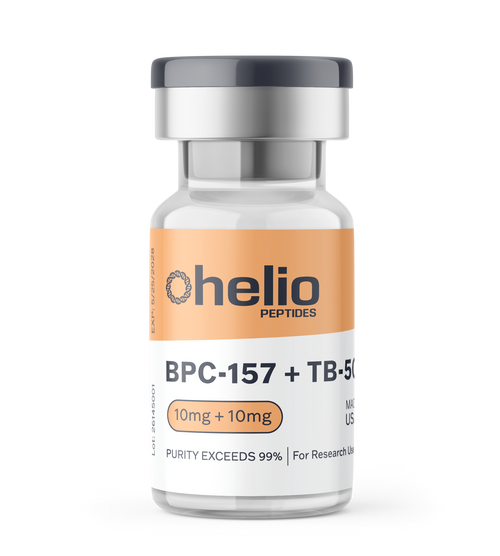
The two peptides are frequently paired in preclinical connective-tissue research because their proposed mechanisms are complementary: BPC-157 emphasizes vascular and nitric-oxide pathways, while TB-500 emphasizes actin-driven cell migration and cytoskeletal remodeling. Helio offers this blend in 5mg+5mg and 10mg+10mg vial configurations. This material is Research Use Only and is not for human or veterinary use.
Format: supplied as dissolvable oral strips (30 per box) — a fast, non-invasive research format. Exact per-strip potency is printed on the packaging.
Research use only — not for human or animal consumption. Per-batch documentation is provided with the material.
Wolverine Blend is a recovery-focused research combination (BPC-157 with TB-500) studied together in tissue-repair research models.
Supplied as dissolvable oral strips — 30 strips per box — for fast, consistent, non-invasive handling in the research setting. Exact per-strip potency is printed on the packaging.
Every batch is independently tested by an ISO 17025-accredited laboratory to ≥99% purity, with a certificate of analysis on file for its exact lot.
For research use only. Not for human or veterinary consumption, diagnosis, or treatment.
Specifications
- MaterialWolverine Blend Dissolvable Strips
- Research AreaRecovery Research
- PresentationDissolvable Strips
- CAS Number137525-51-0 (BPC-157); 77591-33-4 (TB-500 / Thymosin Beta-4)
- Molecular FormulaC62H98N16O22 (BPC-157); C212H350N56O78S (TB-500)
- Molecular Weight~1419.5 g/mol (BPC-157); ~4963.44 g/mol (TB-500)
- TypeBlend of two synthetic peptides (pentadecapeptide + 43-residue Thymosin Beta-4)
- Receptor / TargetBPC-157: VEGFR2 / NO-eNOS-Akt signaling (no defined receptor); TB-500: G-actin sequestration
BPC-157: GEPPPGKPADDAGLV (15 aa); TB-500: Ac-SDKPDMAEIEKFDKSKLKKTETQEKNPLPSKETIEQEKQAGES (43 aa)
- Purity (HPLC)≥99%
- Identity (MS)Confirmed to specification
- TestingAccredited (ISO 17025) third-party laboratory
- DocumentationPer-batch COA →
The BPC-157 / TB-500 pairing is a common preclinical combination in recovery research because the two peptides target distinct but complementary processes, vascular and nitric-oxide signaling for BPC-157 and actin-cytoskeleton regulation and cell migration for TB-500. Individual-compound studies (Sikiric et al. for BPC-157; Malinda et al. and Goldstein et al. for Thymosin Beta-4) document angiogenic and tissue-repair endpoints in rodent and in-vitro models.
No controlled study establishes synergy or human efficacy of the blend itself; the two peptides are simply co-formulated for research convenience. All associated data are experimental and hypothesis-generating.
BPC-157 (from gastric-juice Body Protection Compound, 1990s) and Thymosin Beta-4 (isolated from thymus, characterized since the 1980s) each have independent experimental histories; their combination as a research blend reflects their shared use in connective-tissue and wound-repair studies. Both remain unapproved investigational compounds for laboratory research only.
- Seiwerth S, Brcic L, Vuletic LB, et al. BPC 157 and blood vessels. Current Pharmaceutical Design. 2014;20(7):1121-1125.
- Sikiric P, Seiwerth S, Rucman R, et al. Stable gastric pentadecapeptide BPC 157: novel therapy in gastrointestinal tract. Current Pharmaceutical Design. 2011;17(16):1612-1632.
- Malinda KM, Sidhu GS, Mani H, et al. Thymosin beta4 accelerates wound healing. Journal of Investigative Dermatology. 1999;113(3):364-368.
- Goldstein AL, Hannappel E, Kleinman HK. Thymosin beta4: actin-sequestering protein moonlights to repair injured tissues. Trends in Molecular Medicine. 2005;11(9):421-429.
Cited literature refers to laboratory and preclinical research. This material is supplied strictly for research use only and is not intended to diagnose, treat, cure, or prevent any disease.
Are these research materials third-party tested?
Yes — every batch is analysed by an accredited (ISO 17025) independent laboratory using HPLC and mass spectrometry, with a per-batch Certificate of Analysis.
What purity are the materials?
Materials are verified to 99%+ HPLC purity. Any batch that does not meet the threshold is not released.
Do you provide a Certificate of Analysis (COA)?
Yes. Per-batch COA documentation is provided and is traceable by lot number.
Where do you ship from?
Materials are shipped from the USA in discreet, protective packaging.
Are these products for human use?
No. All materials are sold strictly for laboratory research use only — not for human or animal consumption, diagnosis, treatment, or prevention of any disease.
More Recovery Research materials
RESEARCH USE ONLY · NOT FOR HUMAN OR VETERINARY USE · 21+

