
Aod-9604 - 5MG
About Aod-9604 - 5MG
AOD-9604 is a synthetic 16-amino-acid peptide derived from the C-terminal region (residues 176–191) of human growth hormone (hGH), modified by the addition of a tyrosine residue at the N-terminus. Its sequence is YLRIVQCRSVEGSCGF, and it contains an internal disulfide bridge between the two cysteine residues (Cys7–Cys15). The molecule carries the formula C78H123N23O23S2 (≈81815.12 g/mol), CAS 221231-10-3, and PubChem CID 71300630. Because it corresponds to the lipolytic C-terminal fragment of hGH rather than the full hormone, it has been studied for effects distinct from the growth-promoting actions of intact growth hormone.
AOD-9604 was developed as part of research into the fat-metabolizing region of growth hormone, with the goal of isolating lipid-related activity from the broader metabolic and mitogenic effects of the parent hormone. In preclinical and in-vitro settings it has been used as a model peptide for studying adipocyte lipolysis and lipogenesis. It is supplied here solely as AOD-9604 research material for laboratory investigation.
Research use only — not for human or animal consumption. Per-batch documentation is provided with the material.
Handling and Storage Tips:
Keep peptides cold and away from light once received.
For short-term use (days to weeks), refrigeration at 4°C (39°F) is acceptable.
Lyophilized peptides are typically stable at room temperature for several weeks, making it suitable for moderate-term storage.
For long-term storage (months to years), it’s best to freeze peptides at -80°C (-112°F). Freezing optimally preserves peptide stability for extended periods.
FDA Disclosure & Intended Use:
FDA Disclosure: The statements on this website and the products sold herein have not been evaluated by the U.S. Food and Drug Administration (FDA). These products are not intended to diagnose, treat, cure, or prevent any disease. Products sold are for Research Use Only and are not for human or animal use.
Intended Purpose: Products sold on this site are intended solely for basic laboratory research, pharmaceutical research, or the development of new tests. They are not intended for diagnostic, therapeutic, or clinical use.
Specifications
- MaterialAod-9604 - 5MG
- Also searched asAOD9604, AOD 9604
- Research AreaMetabolic Research
- Presentation—
- CAS Number221231-10-3
- Molecular FormulaC78H123N23O23S2
- Molecular Weight1815.12 g/mol
- TypeModified peptide (hGH 176-191 fragment analog)
- Receptor / TargetGrowth-hormone C-terminal fragment (no classical GH receptor dependence)
- PubChem CID71300630 →
YLRIVQCRSVEGSCGF
- Purity (HPLC)≥99%
- Identity (MS)Confirmed to specification
- TestingAccredited (ISO 17025) third-party laboratory
- DocumentationPer-batch COA →
Additional preclinical work has explored AOD-9604 in models of metabolic regulation and, separately, in connective-tissue and cartilage biology.. All described observations derive from preclinical, experimental, or in-vitro systems and are presented strictly for research context, with no human efficacy implied.
AOD-9604 ("Anti-Obesity Drug 9604") was developed in the 1990s–2000s by researchers at Monash University in Australia, building on work identifying the C-terminal 176–191 region of human growth hormone as the domain associated with lipolytic activity. The N-terminal tyrosine modification was introduced to the native fragment, and the peptide was subsequently evaluated in a series of preclinical and early clinical metabolic studies.
- Ng FM, et al. (2000). Molecular and biochemical characterization of the lipolytic domain of human growth hormone. Journal of Molecular Endocrinology.
- Heffernan M, et al. (2001). The effects of human GH and its lipolytic fragment (AOD9604) on lipid metabolism following chronic treatment in obese mice. Endocrinology.
- Stier H, et al. (2013). Safety and tolerability of the hexadecapeptide AOD9604 in humans. Journal of Endocrinology, Diabetes & Obesity.
View compound profile on NIH PubChem →
Cited literature refers to laboratory and preclinical research. This material is supplied strictly for research use only and is not intended to diagnose, treat, cure, or prevent any disease.
Are these research materials third-party tested?
Yes — every batch is analysed by an accredited (ISO 17025) independent laboratory using HPLC and mass spectrometry, with a per-batch Certificate of Analysis.
What purity are the materials?
Materials are verified to 99%+ HPLC purity. Any batch that does not meet the threshold is not released.
Do you provide a Certificate of Analysis (COA)?
Yes. Per-batch COA documentation is provided and is traceable by lot number.
Where do you ship from?
Materials are shipped from the USA in discreet, protective packaging.
Are these products for human use?
No. All materials are sold strictly for laboratory research use only — not for human or animal consumption, diagnosis, treatment, or prevention of any disease.
More Metabolic Research materials
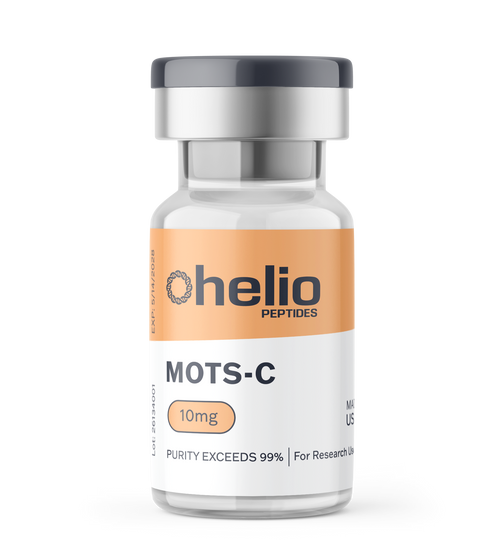 ✓ ≥99% View COA ›
MOTS-c 10MG Research Vial - Mitochondrial-Derived Peptide | Third-Party Tested
RESEARCH USE ONLY · NOT FOR HUMAN OR VETERINARY USE · 21+

