
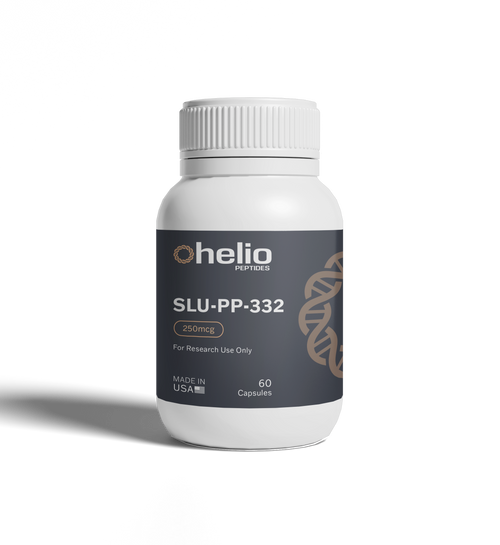
Slu-pp-332 - Capsules - 30CT
About Slu-pp-332 - Capsules - 30CT
SLU-PP-332 is a small-molecule pan-agonist of the estrogen-related receptors (ERRα, ERRβ, ERRγ), not a peptide. Chemically it is the acylhydrazone 4-hydroxy-N'-(naphthalen-2-ylmethylene)benzohydrazide (IUPAC: 4-hydroxy-N-[(Z)-naphthalen-2-ylmethylideneamino]benzamide), with formula C18H14N2O2, molecular weight 290.32 g/mol, CAS 303760-60-3, and PubChem CID 5404083. It activates all three ERR isoforms with reported EC50 values of approximately 98 nM (ERRα), 230 nM (ERRβ), and 430 nM (ERRγ), making it a preferential ERRα agonist within a pan-ERR profile.
SLU-PP-332 was developed at Saint Louis University as a structural optimization of the earlier ERR agonist GSK4716, in which a naphthalene ring replaced the isopropylphenyl group to substantially increase ERRα potency. Because ERRs are master regulators of mitochondrial biogenesis and oxidative metabolism, SLU-PP-332 has been widely studied as an "exercise mimetic" research tool. It is supplied here strictly as SLU-PP-332 research material for laboratory use.
Research use only — not for human or animal consumption. Per-batch documentation is provided with the material.
Handling and Storage Tips:
Keep peptides cold and away from light once received.
For short-term use (days to weeks), refrigeration at 4°C (39°F) is acceptable.
Lyophilized peptides are typically stable at room temperature for several weeks, making it suitable for moderate-term storage.
For long-term storage (months to years), it’s best to freeze peptides at -80°C (-112°F). Freezing optimally preserves peptide stability for extended periods.
FDA Disclosure & Intended Use:
FDA Disclosure: The statements on this website and the products sold herein have not been evaluated by the U.S. Food and Drug Administration (FDA). These products are not intended to diagnose, treat, cure, or prevent any disease. Products sold are for Research Use Only and are not for human or animal use.
Intended Purpose: Products sold on this site are intended solely for basic laboratory research, pharmaceutical research, or the development of new tests. They are not intended for diagnostic, therapeutic, or clinical use.
Specifications
- MaterialSlu-pp-332 - Capsules - 30CT
- Also searched asSLU PP 332, SLUPP332
- Research AreaMetabolic Research
- Presentation—
- CAS Number303760-60-3
- Molecular FormulaC18H14N2O2
- Molecular Weight290.32 g/mol
- TypeSmall molecule (acylhydrazone; pan-ERR agonist)
- Receptor / TargetEstrogen-related receptors ERRα / ERRβ / ERRγ
- PubChem CID5404083 →
- Purity (HPLC)≥99%
- Identity (MS)Confirmed to specification
- TestingAccredited (ISO 17025) third-party laboratory
- DocumentationPer-batch COA →
Because ERR activation overlaps with transcriptional adaptations to exercise, SLU-PP-332 has been characterized in the literature as an "exercise mimetic" tool compound and studied in cardiac-metabolism and endurance-adaptation contexts.. All described observations derive from preclinical, experimental, or in-vitro models and are presented for research context only.
SLU-PP-332 was developed at Saint Louis University School of Medicine by the laboratory of Thomas Burris as a structural optimization of the ERR agonist GSK4716. Replacing GSK4716's isopropylphenyl group with a naphthalene ring increased ERRα potency roughly 50-fold, yielding a pan-ERR agonist that has since been characterized across multiple peer-reviewed studies of metabolic syndrome, mitochondrial biogenesis, and exercise-adaptation pathways.
- Xu W, et al. (2017). Small molecule agonists of the orphan nuclear receptors ERRα and ERRγ. (ERR agonist series characterizing SLU-PP-332). Journal / preclinical report.
- Billon C, et al. (2023). Synthetic ERR agonist SLU-PP-332 increases energy expenditure and fatty acid oxidation and counteracts metabolic syndrome. Journal of Pharmacology and Experimental Therapeutics.
- Billon C, et al. (2024). The ERR agonist SLU-PP-332 as an exercise mimetic. (Preclinical characterization of exercise-adaptation pathways).
View compound profile on NIH PubChem →
Cited literature refers to laboratory and preclinical research. This material is supplied strictly for research use only and is not intended to diagnose, treat, cure, or prevent any disease.
Are these research materials third-party tested?
Yes — every batch is analysed by an accredited (ISO 17025) independent laboratory using HPLC and mass spectrometry, with a per-batch Certificate of Analysis.
What purity are the materials?
Materials are verified to 99%+ HPLC purity. Any batch that does not meet the threshold is not released.
Do you provide a Certificate of Analysis (COA)?
Yes. Per-batch COA documentation is provided and is traceable by lot number.
Where do you ship from?
Materials are shipped from the USA in discreet, protective packaging.
Are these products for human use?
No. All materials are sold strictly for laboratory research use only — not for human or animal consumption, diagnosis, treatment, or prevention of any disease.
More Metabolic Research materials
 ✓ ≥99% View COA ›
MOTS-c 10MG Research Vial - Mitochondrial-Derived Peptide | Third-Party Tested
RESEARCH USE ONLY · NOT FOR HUMAN OR VETERINARY USE · 21+

