MOTS-c 10MG Research Vial - Mitochondrial-Derived Peptide | Third-Party Tested
MOTS-c 10MG Research Vial - Mitochondrial-Derived Peptide | Third-Party Tested
Couldn't load pickup availability
A single-component research material supplied for controlled research environments. Suitable for studies involving mitochondrial-derived peptide characterization and method development in model systems.
Free Shipping
On $100+
250K+ Peptides
Delivered
USA Made
& Sourced
Research Use Only
All products are intended solely for laboratory research and are not for human or animal consumption. By purchasing, the buyer agrees to use these products in compliance with all applicable laws.


MOTS-c Research That Actually Gets Used
Mitochondrial biology has shifted from the periphery to the centre of metabolic and ageing research. The discovery that the mitochondrial genome encodes its own signalling peptides - compounds capable of coordinating systemic physiological responses independently of nuclear gene expression - has opened a fundamentally new research direction.
MOTS-c sits at the heart of that direction.
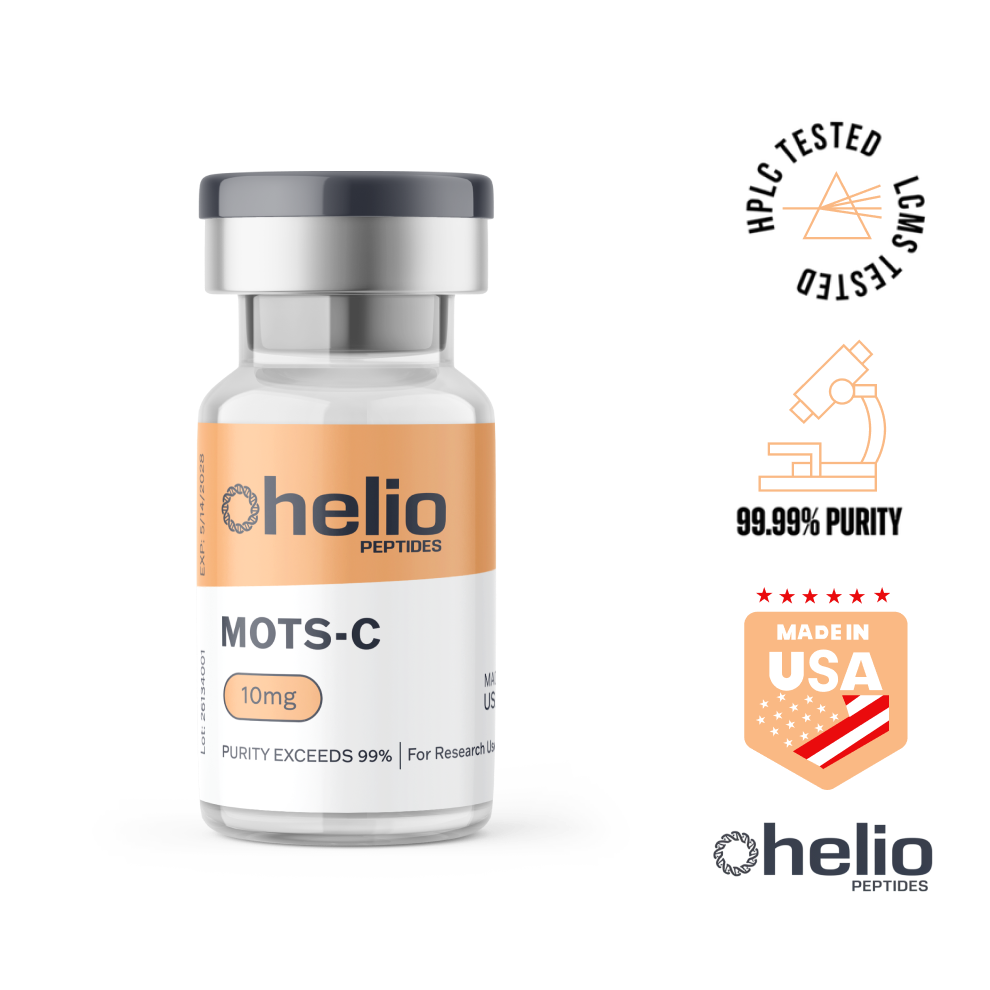
Every vial of MOTS-c from Helio Peptides goes through independent third-party testing at an ISO 17025-accredited laboratory before it ships - identity confirmed by HPLC, molecular weight verified by mass spectrometry, and assay content confirmed at the labelled 10MG. The Certificate of Analysis is available on request for every batch.
MOTS-c (Mitochondrial Open reading frame of the twelve S rRNA-c) is a 16-amino acid peptide encoded within the 12S ribosomal RNA gene of the human mitochondrial genome - making it one of a small class of mitochondria-derived peptides (MDPs) with documented intercellular signalling activity. Published research has characterised MOTS-c as an AMPK pathway activator with effects on insulin sensitivity, glucose homeostasis, fatty acid oxidation, physical performance, and mitochondrial stress responses. At $49.95 per vial - or $44.96 in a pack of ten - Helio Peptides provides one of the most rigorously documented and cost-accessible sources of research-grade MOTS-c from a US-based, ISO-accredited tested supplier. Researchers building comprehensive mitochondrial biology programmes may also be examining our SLU-PP-332 5MG Vial - the pan-ERR agonist exercise mimetic - alongside MOTS-c for a complementary transcriptional and peptide-mediated approach to mitochondrial function research.
What Makes This Vial Different
MOTS-c is available from multiple research peptide suppliers. Documentation quality is what separates them. Here's what sets the Helio Peptides MOTS-c 10MG vial apart:
Third-party tested at an ISO 17025-accredited lab. The laboratory conducting the testing has been independently verified for technical accuracy - not self-certified. Every Helio Peptides MOTS-c batch is tested at such a facility. Full batch data is documented in our Certificate of Analysis, available on request.
USA manufactured. Synthesised by solid-phase peptide synthesis (SPPS) in a controlled US-based facility. The 16-amino acid sequence is confirmed at every batch by mass spectrometry. Not imported raw material relabelled domestically - manufactured, tested, and dispatched from the United States.
Sequence confirmed by mass spectrometry at every batch. MOTS-c's 16-amino acid sequence - MRWQEMGYIFYPRKLR - is verified by MS at every production batch. Sequence errors, truncated forms, and oxidation artefacts are among the known failure modes in lower-quality peptide synthesis. MS confirmation rules them out.
Lyophilised for stability. Supplied as lyophilised powder - substantially more stable than solution formats during shipping and storage. Cold-chain packaging included on every order.
Transparent pricing with a bulk option. $49.95 single vial. $44.96 per vial in a pack of ten - a 10% saving for research programmes requiring consistent supply.
What Is MOTS-c?
MOTS-c (Mitochondrial Open reading frame of the twelve S rRNA-c) is a 16-amino acid peptide encoded by a short open reading frame (sORF) within the 12S ribosomal RNA (12S rRNA) gene of the human mitochondrial genome. It was first characterised by Lee et al. in 2015 in a landmark Cell Metabolism publication that identified it as a hormonally active peptide capable of translocating from the mitochondria to the nucleus to regulate gene expression in response to metabolic stress.
MOTS-c belongs to a broader class of mitochondria-derived peptides (MDPs) - a recently characterised family of bioactive signalling peptides encoded by the mitochondrial genome, which also includes Humanin and the SHLP (Small Humanin-Like Peptide) family. MOTS-c is unique within this class for its nuclear translocation capacity - in response to metabolic stress (such as glucose restriction, oxidative stress, or folate cycle disruption), MOTS-c translocates from the mitochondria to the nucleus, where it acts as a transcriptional regulator of AMPK-dependent metabolic gene expression programmes.
Its primary mechanistic action involves activation of the AMPK (AMP-activated protein kinase) pathway - a central cellular energy sensor that responds to falling ATP/AMP ratios by inhibiting anabolic processes and stimulating catabolic pathways (fatty acid oxidation, glucose uptake, autophagy). MOTS-c's capacity to activate AMPK signalling through a mitochondria-to-nucleus communication axis represents a novel and previously uncharacterised mechanism for mitochondrial regulation of whole-cell energy homeostasis.
MOTS-c circulates in human plasma and has been detected in skeletal muscle, liver, heart, and adipose tissue in published studies. Plasma MOTS-c levels decline with age and are lower in obese and insulin-resistant individuals compared to lean controls in published human data - establishing it as a potentially meaningful biomarker in metabolic ageing research as well as a research tool. MOTS-c is a fundamentally different compound from our SLU-PP-332 5MG Vial - which activates ERR nuclear receptors through a synthetic small-molecule mechanism - and from our Epithalon 10MG Vial - which targets telomerase activity and bioregulator pathways. All three are studied in ageing and metabolic biology but through entirely different and complementary molecular mechanisms.
|
"MOTS-c is one of the most exciting discoveries in mitochondrial biology of the past decade. A peptide encoded by the mitochondrial genome that translocates to the nucleus to regulate metabolic gene expression - this is a completely novel communication axis, and MOTS-c is the primary research tool for studying it." - Mitochondrial biology research community on the significance of MOTS-c |
Research Applications
MOTS-c has been investigated across multiple documented research directions since its initial characterisation in 2015. The pace of published research on MOTS-c has accelerated significantly since 2019. All applications described below are for controlled laboratory environments only. This product is for research use only and is not for human or animal consumption.
AMPK Pathway Activation and Cellular Energy Sensing
The primary mechanistic research application for MOTS-c is characterisation of its role in AMPK pathway activation and mitochondrial-to-nuclear stress signalling. Published studies have demonstrated that MOTS-c activates AMPK in skeletal muscle, liver, and adipose tissue - phosphorylating ACC (acetyl-CoA carboxylase) to inhibit fatty acid synthesis and stimulate beta-oxidation, and activating GLUT4 translocation to the plasma membrane to increase glucose uptake independently of insulin signalling.
Research in this area includes cell-based AMPK phosphorylation assays (Western blot, ELISA), glucose uptake measurements in skeletal muscle cell lines (C2C12), fatty acid oxidation assays in primary hepatocytes and adipocytes, and characterisation of MOTS-c's effects on the AMPK/mTOR signalling axis - which governs the balance between catabolism and anabolic processes including protein synthesis and autophagy induction.
Researchers investigating AMPK pathway biology from multiple mechanistic angles may compare MOTS-c (mitochondria-to-nucleus peptide signalling) with our SLU-PP-332 5MG Vial (ERR nuclear receptor transcriptional activation) - both ultimately converge on overlapping metabolic gene expression programmes through distinct upstream mechanisms. Understanding how these pathways interact, reinforce, or diverge is an emerging direction in mitochondrial pharmacology research.
Insulin Sensitivity and Glucose Homeostasis Research
A well-characterised research application for MOTS-c is its investigation in insulin sensitivity and glucose homeostasis model systems. The foundational Cell Metabolism (2015) publication by Lee et al. demonstrated that MOTS-c administration in murine models improved insulin sensitivity, reduced adiposity in diet-induced obesity models, and enhanced glucose tolerance in both high-fat-diet and aged murine systems.
Subsequent research has examined the mechanism - specifically MOTS-c's capacity to activate AMPK in skeletal muscle independently of upstream insulin receptor signalling, providing a potential route to glucose uptake that bypasses insulin resistance. This has generated research interest in MOTS-c as a model compound for studying alternative insulin-independent glucose disposal pathways in metabolic syndrome, type 2 diabetes, and ageing-related insulin resistance model systems.
Researchers examining insulin sensitivity across multiple mechanistic approaches may also be working with our Tesamorelin Vial for GH-axis metabolic research or our AOD-9604 Vial for GH fragment lipolysis studies - covering complementary aspects of metabolic dysregulation research.
Physical Performance and Exercise Adaptation Research
A 2021 publication in Nature Aging demonstrated that exogenous MOTS-c administration in aged murine models improved physical performance - specifically running endurance and grip strength - and reversed age-related declines in skeletal muscle metabolic capacity. The mechanism was linked to MOTS-c's capacity to restore AMPK signalling and mitochondrial function in aged skeletal muscle tissue, where mitochondrial quality control mechanisms decline with age.
This finding has positioned MOTS-c alongside our SLU-PP-332 5MG Vial as one of the most studied peptide-based exercise biology research compounds. The mechanistic distinction is significant: SLU-PP-332 drives ERR-mediated transcriptional activation of mitochondrial biogenesis genes (a genomic mechanism); MOTS-c activates AMPK through a mitochondria-to-nucleus peptide signalling mechanism (a non-genomic rapid response pathway). Studying both in parallel allows systematic dissection of transcriptional versus post-translational routes to improved mitochondrial function in skeletal muscle.
Ageing, Longevity, and Mitochondrial Decline Research
MOTS-c has attracted significant research interest as both a biomarker and interventional tool in ageing biology. Published studies have documented age-related declines in circulating MOTS-c levels in both murine and human cohorts - with the steepest declines observed in the 40–70 age range in human cross-sectional data. This decline correlates with well-established metabolic changes in ageing including reduced insulin sensitivity, increased adiposity, sarcopenia, and declining mitochondrial respiratory capacity in skeletal muscle.
Research in this area has examined MOTS-c as a potential modulator of the hallmarks of ageing - specifically mitochondrial dysfunction, cellular senescence, altered intercellular communication, and deregulated nutrient sensing - in murine lifespan and healthspan model systems. Researchers building comprehensive ageing biology programmes may combine MOTS-c research with our Epithalon 10MG Vial (telomere biology and telomerase activation), our Thymosin Alpha 1 5MG Vial (immune ageing and immunosenescence), and our GHK-Cu 50MG Vial (extracellular matrix remodelling in ageing tissue) - covering complementary hallmarks of ageing through distinct molecular mechanisms.
Mitochondrial Stress Response and Hormesis Research
A particularly well-characterised aspect of MOTS-c biology is its role in the mitochondrial stress response - specifically its release from mitochondria under conditions of metabolic stress including glucose restriction, reactive oxygen species (ROS) accumulation, and folate cycle perturbation. This stress-responsive release pattern makes MOTS-c a research tool for studying the concept of mitohormesis - the phenomenon by which moderate mitochondrial stress produces adaptive protective responses through signalling peptide release.
Research in this area examines the upstream signals that trigger MOTS-c release from mitochondria, the transcriptional programmes activated when MOTS-c translocates to the nucleus, and the downstream cytoprotective effects in cellular stress models including ischaemia-reperfusion injury, oxidative stress, and nutrient deprivation. Researchers interested in mitochondrial stress signalling may also be working with our BPC-157 Vial in parallel cytoprotection research - BPC-157's published effects on nitric oxide signalling and cellular stress responses in GI and systemic models complement MOTS-c's mitochondrial stress biology from a different mechanistic angle.
Folate Cycle and One-Carbon Metabolism Research
A distinctive and mechanistically novel finding in MOTS-c research is its documented interaction with the folate cycle - specifically its regulation of AICAR (5-aminoimidazole-4-carboxamide ribonucleotide) accumulation in the purine de novo synthesis pathway. Disruption of the folate cycle by methotrexate or other antifolate agents triggers MOTS-c release and subsequent AMPK activation - establishing a direct link between one-carbon metabolism, mitochondrial peptide signalling, and cellular energy sensing. This makes MOTS-c relevant to researchers studying the intersection of nucleotide metabolism, mitochondrial function, and AMPK biology - a mechanistic axis with implications for cancer metabolism research, where folate pathway disruption is a well-established therapeutic strategy.
Product Specifications
|
Specification |
Detail |
|
Peptide Name |
MOTS-c (Mitochondrial Open reading frame of the twelve S rRNA-c) |
|
Peptide Class |
Mitochondria-derived peptide (MDP) |
|
CAS Number |
1627580-64-6 |
|
Molecular Formula |
C₁₀₁H₁₆₃N₃₃O₂₄ |
|
Molecular Weight |
2,174.62 g/mol |
|
Amino Acid Count |
16 amino acids |
|
Sequence |
MRWQEMGYIFYPRKLR |
|
Genomic Origin |
12S rRNA gene of the human mitochondrial genome (sORF) |
|
Primary Mechanism |
AMPK pathway activation via mitochondria-to-nucleus translocation |
|
Vial Size |
10MG lyophilised powder |
|
Synthesis Method |
Solid-phase peptide synthesis (SPPS) |
|
Purity |
≥99% - HPLC and mass spectrometry confirmed |
|
Testing Facility |
ISO 17025-accredited third-party laboratory |
|
Manufacture |
USA - controlled facility |
|
Short-Term Storage |
Refrigerate at 4°C (39°F) - days to weeks |
|
Long-Term Storage |
Freeze at -80°C (-112°F) - months to years |
|
Reconstitution |
Bacteriostatic water or sterile water - research use only |
|
Solubility |
Freely soluble in water |
|
Price (Single) |
$49.95 |
|
Price (Pack of 10) |
$44.96 per vial - 10% saving |
|
Intended Use |
Laboratory research only. Not for human or animal consumption. |
Purity Testing & Certificate of Analysis
Every batch of Helio Peptides MOTS-c is independently tested before release. Not sampled - every batch. Testing is conducted by an ISO 17025-accredited third-party laboratory:
-
HPLC (High-Performance Liquid Chromatography): Separates and quantifies the peptide against certified reference standards - confirms identity, detects synthesis by-products and oxidation artefacts, verifies purity at ≥99%
-
Mass Spectrometry (MS): Confirms the exact molecular mass at 2,174.62 g/mol - verifies the 16-amino acid sequence MRWQEMGYIFYPRKLR and rules out truncated forms, substitutions, and synthesis artefacts
-
Assay / Content Testing: Confirms the exact quantity of active MOTS-c per vial matches the labelled 10MG
The COA for any specific batch is available on request. Email info@heliopeptides.com with your order number and batch details. For a full explanation of COA methodology and how to interpret HPLC and MS data, visit our Certificate of Analysis and Testing page. For reconstitution guidance and handling protocols, see our FAQ page.
How to Reconstitute MOTS-c
MOTS-c is supplied as a lyophilised powder and is freely soluble in water, making reconstitution straightforward.
-
Allow the vial to reach room temperature before opening - prevents moisture condensation on the peptide powder
-
Draw the required volume of bacteriostatic water (BW) or sterile water for injection (SWFI) using a sterile needle and syringe
-
Inject the diluent slowly along the inner wall of the vial - not directly onto the lyophilised powder
-
Gently swirl in a circular motion until fully dissolved - MOTS-c's high water solubility means the solution clears quickly. Do not shake or vortex
-
Inspect the solution - it should be clear and colourless. Discard if cloudiness or particulates are visible
-
Store reconstituted solution at 4°C and use within 2–4 weeks, or aliquot and freeze at -80°C for longer-term storage
Bacteriostatic water is preferred for reconstituted storage - its 0.9% benzyl alcohol content inhibits microbial growth and extends stable use window. For cell-based assays, further dilute the reconstituted stock in sterile PBS or appropriate assay buffer. Published in vivo murine protocols have typically used subcutaneous or intraperitoneal administration in sterile saline vehicle. For complete handling guidance, visit our FAQ page.
Storage Guidelines
MOTS-c's 16-amino acid sequence includes tryptophan (Trp, W) and tyrosine (Tyr, Y) residues that are sensitive to photooxidation. Protect from direct light throughout storage and handling.
-
On delivery: refrigerate immediately - do not leave at room temperature for extended periods
-
Short-term (days to weeks): refrigerate at 4°C, in original or opaque packaging away from direct light
-
Long-term (months to years): freeze at -80°C - optimal for extended peptide stability and photooxidation prevention
-
Avoid repeated freeze-thaw cycles: aliquot into single-use volumes before freezing if the vial will be accessed across multiple sessions
-
Reconstituted solution: stable at 4°C for 2–4 weeks. Freeze aliquots at -80°C for longer storage - store in light-protected vials where possible
-
Light protection: wrap stored vials in foil or use opaque storage containers - tryptophan and tyrosine photooxidation is the primary degradation concern for MOTS-c in storage
Helio Peptides ships all vials with cold-chain packaging. Contact info@heliopeptides.com or call 1-855-435-4633 immediately if you have any concerns about vial condition upon arrival.
The Dosing Breakdown
|
Format |
Detail |
|
Vial size |
10MG lyophilised MOTS-c |
|
Single vial price |
$49.95 |
|
Pack of 10 price |
$44.96 per vial - 10% saving - $449.60 total |
|
Total in pack of 10 |
100MG MOTS-c across 10 vials |
|
Best for |
Mitochondrial biology, AMPK pathway, ageing, insulin sensitivity, and exercise adaptation research programmes |
The 10MG vial provides sufficient material for extensive in vitro AMPK signalling assays across multiple concentration ranges, and for multi-dose in vivo murine studies. For research programmes requiring consistent batch-matched supply, the pack of ten at $44.96 per vial is the most cost-efficient format. For institutional or wholesale pricing, contact our wholesale team directly.
How MOTS-c Fits the Helio Lineup
When to choose MOTS-c: Your research involves mitochondrial-derived peptide signalling, AMPK pathway activation, insulin sensitivity without insulin receptor engagement, exercise adaptation mechanisms in aged model systems, mitochondrial stress response biology, or folate cycle and one-carbon metabolism research. MOTS-c is the primary research tool for studying the mitochondria-to-nucleus peptide communication axis.
When to also consider SLU-PP-332: Our SLU-PP-332 5MG Vial activates ERR nuclear receptors to drive mitochondrial biogenesis gene expression - a transcriptional route to improved mitochondrial function that is mechanistically distinct from MOTS-c's AMPK activation pathway. The two compounds are increasingly studied in parallel to dissect transcriptional versus non-genomic routes to mitochondrial adaptation.
When to also consider Epithalon: For ageing biology programmes combining mitochondrial function research with telomere and longevity biology, our Epithalon 10MG Vial covers telomerase activation and bioregulator mechanisms - complementary to MOTS-c's mitochondrial ageing research applications.
When to also consider Thymosin Alpha 1: For multi-system ageing programmes examining both mitochondrial decline and immune ageing in parallel, our Thymosin Alpha 1 5MG Vial covers immunosenescence, TLR pathway modulation, and T-cell differentiation research alongside MOTS-c's metabolic ageing work.
When to also consider GHK-Cu: For research programmes combining metabolic and mitochondrial biology with extracellular matrix and tissue remodelling endpoints, our GHK-Cu 50MG Vial covers collagen synthesis, wound healing, and skin regeneration research - frequently run alongside MOTS-c in comprehensive ageing biology programmes.
When to also consider BPC-157: For programmes combining mitochondrial research with systemic repair and cytoprotection endpoints, our BPC-157 Vial covers GI, tendon, and systemic tissue repair models - a complement to MOTS-c's metabolic and mitochondrial research directions.
When to also consider Tesamorelin or AOD-9604: For metabolic syndrome programmes combining AMPK-mediated insulin sensitivity research (MOTS-c) with GH-axis metabolic research, our Tesamorelin Vial and AOD-9604 Vial cover GH-axis-mediated lipid metabolism and visceral adiposity research - complementary mechanisms to MOTS-c's AMPK-driven metabolic improvements.
Shipping & Fulfilment
|
Detail |
Policy |
|
Same-Day Dispatch |
Orders placed before the daily cut-off ship same day from our US facility |
|
Free Shipping |
On all orders over $100 |
|
Domestic Delivery |
1–3 business days within the USA |
|
Cold-Chain Packaging |
All vials ship with cold-chain protection to maintain peptide integrity in transit |
|
Payment Methods |
Credit/debit card (3D Secure), bank transfer, ETH, BTC, USDC |
|
Customer Service |
1-855-435-4633 · info@heliopeptides.com · Live Chat on site |
Frequently Asked Questions
What is MOTS-c used for in research?
MOTS-c is studied in controlled laboratory settings for AMPK pathway activation, insulin sensitivity and glucose homeostasis research, physical performance and exercise adaptation in aged models, mitochondrial stress response and hormesis biology, ageing and longevity research, and folate cycle / one-carbon metabolism studies. Research use only - not for human or animal consumption.
What makes MOTS-c different from other metabolic research peptides?
MOTS-c is unique in being encoded by the mitochondrial genome - specifically by a short open reading frame within the 12S rRNA gene - rather than the nuclear genome. This makes it a mitochondria-derived peptide (MDP) capable of mitochondria-to-nucleus translocation in response to metabolic stress, activating AMPK through a novel peptide signalling axis that is entirely distinct from surface receptor agonists like GLP-1 analogues or nuclear receptor ligands like our SLU-PP-332 5MG Vial.
What is the molecular weight of MOTS-c?
2,174.62 g/mol. Molecular formula C₁₀₁H₁₆₃N₃₃O₂₄. CAS number 1627580-64-6. 16-amino acid sequence: MRWQEMGYIFYPRKLR. Encoded by the 12S rRNA gene of the human mitochondrial genome.
What is the AMPK pathway and why is it relevant to MOTS-c research?
AMPK (AMP-activated protein kinase) is a central cellular energy sensor - it is activated when intracellular AMP:ATP ratios rise (indicating low energy status) and responds by inhibiting anabolic processes and stimulating catabolic pathways including fatty acid oxidation, glucose uptake (via GLUT4 translocation), and autophagy. MOTS-c activates AMPK through its mitochondria-to-nucleus signalling mechanism - providing a route to AMPK activation that is independent of the upstream insulin receptor pathway, making it particularly relevant for studying insulin-independent glucose disposal and the metabolic consequences of mitochondrial stress signalling.
What published research exists on MOTS-c?
Key publications include: Lee et al., Cell Metabolism (2015) - discovery paper characterising MOTS-c as a mitochondria-encoded peptide hormone with effects on glucose metabolism and insulin sensitivity; Reynolds et al., Nature Aging (2021) - MOTS-c administration improves physical performance and reverses age-related metabolic decline in mice; Kim et al., Communications Biology (2022) - circulating MOTS-c levels correlate with metabolic health markers in human cohorts. Additional publications in Aging, Journal of Cachexia Sarcopenia and Muscle, and Cell Reports. CAS: 1627580-64-6.
How do I reconstitute MOTS-c?
Add bacteriostatic water or sterile water slowly along the inner vial wall. Gently swirl until dissolved - MOTS-c is freely soluble in water. Do not shake. Protect from direct light throughout reconstitution and storage. Full protocol on our FAQ page.
How should I store MOTS-c?
Short-term: 4°C, protected from light. Long-term: -80°C, in opaque or foil-wrapped vials - tryptophan (Trp) and tyrosine (Tyr) residues in the sequence are susceptible to photooxidation. Avoid repeated freeze-thaw cycles. Reconstituted solution: 4°C for 2–4 weeks, or -80°C in aliquots for longer storage.
Is every batch of MOTS-c third-party tested?
Yes - every batch. ISO 17025-accredited laboratory testing confirms identity, purity (≥99%), and assay content at 10MG. Sequence verification by MS confirms the 16-amino acid MRWQEMGYIFYPRKLR sequence at every batch. Visit our Certificate of Analysis page or email info@heliopeptides.com to request your batch COA.
Where is Helio Peptides MOTS-c manufactured?
Synthesised in the United States by solid-phase peptide synthesis (SPPS) in a controlled US-based facility. USA made, USA tested, shipped same day with cold-chain packaging.
What is the difference between MOTS-c and Humanin?
Both MOTS-c and Humanin are mitochondria-derived peptides (MDPs) encoded by the human mitochondrial genome. Humanin is a 21-amino acid peptide encoded by the 16S rRNA gene, primarily studied for cytoprotection, anti-apoptotic signalling, and neuroprotection in Alzheimer's disease models. MOTS-c is a 16-amino acid peptide encoded by the 12S rRNA gene, primarily studied for AMPK activation, metabolic regulation, and exercise/ageing biology. The two operate through distinct mechanisms and represent complementary MDPs for studying mitochondrial signalling biology.
What is the difference between MOTS-c and SLU-PP-332 in metabolic research?
MOTS-c is a peptide that translocates from mitochondria to the nucleus to activate AMPK signalling - a rapid, non-genomic metabolic stress response mechanism. Our SLU-PP-332 5MG Vial is a synthetic small molecule that activates ERR nuclear receptors to drive transcriptional upregulation of mitochondrial biogenesis genes - a genomic, transcriptional mechanism. Both improve metabolic outcomes and mitochondrial function in murine models, through entirely different upstream mechanisms that are increasingly studied in combination.
Does Helio Peptides ship internationally?
Contact info@heliopeptides.com or call 1-855-435-4633 for current international shipping availability. Domestic US orders: same-day dispatch, 1–3 business day delivery.
What payment methods are accepted?
Credit/debit card (3D Secure), bank transfer, Ethereum (ETH), Bitcoin (BTC), and USDC at locked exchange rates.
Is MOTS-c legal to buy in the USA?
MOTS-c is sold as a research chemical for laboratory use only. It is not a scheduled controlled substance in the United States and is not FDA-approved for human use. All purchases must comply with applicable federal and state laws. Buyers confirm research intent at checkout.
What does the Certificate of Analysis include?
Batch number, testing date, ISO 17025 facility credentials, HPLC chromatogram confirming identity and purity at ≥99%, mass spectrometry data confirming molecular weight at 2,174.62 g/mol and sequence MRWQEMGYIFYPRKLR, and assay result confirming 10MG content. Request via our Certificate of Analysis page or email info@heliopeptides.com with your order number.
Is there a bulk discount on MOTS-c?
Yes. Pack of 10 at $44.96 per vial - 10% saving over the $49.95 single price, $449.60 total for 100MG. For larger institutional or wholesale quantities, contact our wholesale team.
Explore More From Helio Peptides
-
SLU-PP-332 5MG Vial - pan-ERR agonist, ERR transcriptional activation, mitochondrial biogenesis research
-
Epithalon 10MG Vial - telomere biology, telomerase activation, longevity research
-
Thymosin Alpha 1 5MG Vial - immune modulation, immunosenescence, ageing biology research
-
GHK-Cu 50MG Vial - copper peptide, extracellular matrix remodelling, collagen synthesis research
-
BPC-157 Vial - tissue repair, cytoprotection, systemic repair research
-
Tesamorelin Vial - GH-axis metabolic research, lipodystrophy and visceral adiposity models
-
AOD-9604 Vial - GH fragment, lipolysis and adipose tissue biology research
-
IGF-1 LR3 Vial - long-acting IGF-1 analogue, downstream GH and anabolic signalling research
-
TB-500 5MG Vial - thymosin beta-4 fragment, tissue regeneration and repair research
-
Certificate of Analysis & Testing - full explanation of our ISO 17025 testing methodology
-
Wholesale & Bulk Orders - institutional pricing for research programmes requiring consistent supply
All products sold on heliopeptides.com are intended solely for laboratory research and are not for human or animal consumption. These statements have not been evaluated by the Food and Drug Administration. These products are not intended to diagnose, treat, cure, or prevent any disease. By purchasing, the buyer confirms they are a qualified researcher and agrees to comply with all applicable federal and state laws. Not for sale to persons under the age of 21.
Why COAs Matter
“Purity” is a term most accurately used for raw peptide materials such as isolated compounds or lyophilized powders, where a single ingredient is measured against possible impurities. In these cases, purity testing helps confirm how much of the material is the intended peptide and how much may be made up of unwanted substances.
For finished products like capsules, tablets, or liquid sprays, the formulation contains additional ingredients such as stabilizers, fillers, and other supporting compounds. Because of this, using the word “purity” can be misleading, since the product is no longer a single isolated substance.
Instead, the most reliable and meaningful testing method for finished products focuses on reporting:
• Identity of the target peptide
• Assay or content, confirming the exact labeled amount per capsule or spray
All products are tested by an ISO 17025-accredited analytical laboratory to maintain consistency, transparency, quality, and trusted results.
How It Works
Order Online
Precision. Purity. Delivered fast.
Precision Lyophilization
Made in a controlled, U.S based facility under strict manufacturing standards.
Verified Purity
Every batch is third-party tested with HPLC and MS to confirm chemical integrity.
Same-Day Fulfillment
Products are dispatched same-day from our U.S. facility.
Frequently Asked Questions
Are your product tested?
Yes, every single batch is third-party tested using HPLC and mass
spectrometry to ensure 99%+ purity. We provide a Certificate of Analysis
(COA) upon request.
Where do you ship from?
All orders are shipped from our U.S.-based facility with same-day fulfillment on orders placed before the cutoff time.
Do you ship internationally?
We ship both domestically and internationally. Our logistics network
supports researchers across the globe with reliable, discreet shipping.
Are these for human consumptions?
No. All products are strictly for laboratory research purposes only and are not intended for human or animal consumption.
How should I store these products?
Store all peptides in a cool, dry place away from direct light. Lyophilized peptides should be kept at -20°C for long-term storage.
What payment methods are accepted?
We accept all major credit cards, debit cards, and other secure payment methods available at checkout.